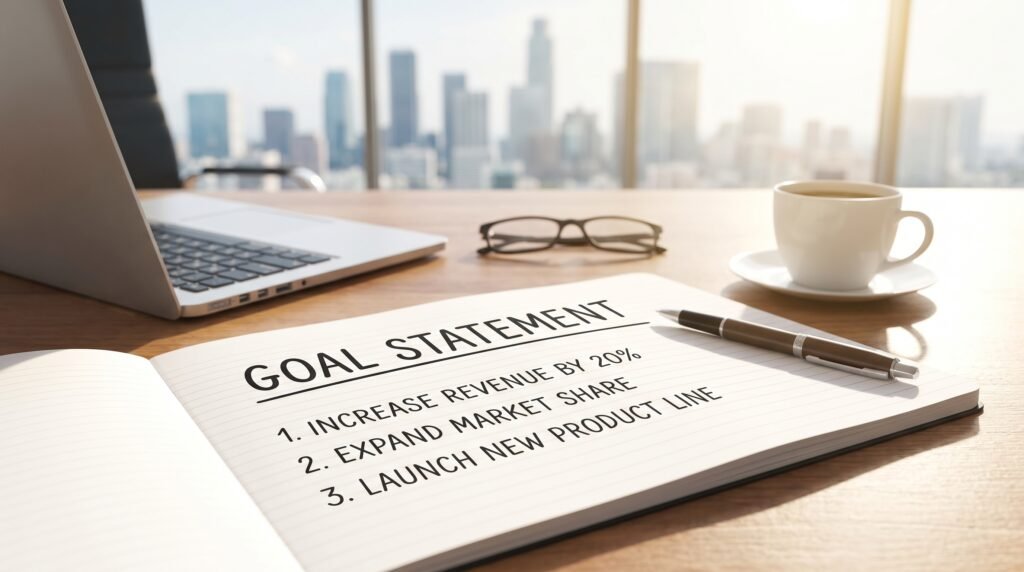
It’s January 2nd. You’ve just written your goals in a fresh notebook — maybe even color-coded them. You feel energized, clear-headed, and genuinely ready to make this your year.
Then February arrives.
A work deadline swallows your week. A family emergency reshuffles your schedule. Your gym bag sits untouched by the door. And somewhere between the chaos and the exhaustion, those beautiful goals quietly collect dust.
Sound familiar? You’re not alone — and more importantly, you’re not broken.
Here’s the truth that most goal-setting advice gets completely wrong: the reason most people fall off track has nothing to do with motivation, willpower, or discipline. It has everything to do with how their goals were designed in the first place.
In this article, I’m not going to hand you a generic pep talk or a color-coded planner template. Instead, you’re going to walk away with a practical, real-world framework for how to stay on track with goals — one that’s flexible enough to survive the messy, unpredictable, beautiful chaos that is everyday life.
- Why Most People Fall Off Track (It's Not What You Think)
- The Foundation: Set Goals That Are Built to Survive Real Life
- How to Stay on Track with Goals: 7 Strategies That Actually Work
- How to Stay on Track During Life's Busiest Seasons
- The Role of Accountability: Going Further Together
- Final Thoughts
- Frequently Asked Questions
Why Most People Fall Off Track (It’s Not What You Think)
Let’s start by dismantling the biggest myth in the goal-setting world: that motivation is the key to staying on track.
It’s not.
Motivation is a spark — it gets you started. But sparks don’t sustain fires. Systems do. Research consistently shows that relying on motivation alone to pursue long-term goals is a losing strategy, because motivation is inherently temporary. It ebbs and flows with your mood, your energy levels, and your circumstances. The people who consistently achieve their goals aren’t more motivated than you — they’ve built better systems that work even on the days motivation is nowhere to be found.
Then there’s the problem of goal overload. Most people kick off the year with a sprawling list of ambitions: lose weight, get promoted, travel more, save money, read 30 books, learn Spanish. What they’re actually creating is a recipe for decision fatigue. When everything is a priority, nothing is. Spreading your focus too thin doesn’t just slow your progress — it often stops it altogether.
And then life happens. An unexpected illness. A demanding project at work. A relationship that needs attention. These aren’t excuses — they’re facts of being human. The problem isn’t that life gets busy (it always will). The problem is that most goal-setting approaches are designed for ideal conditions that rarely exist.
Here’s the most important reframe in this entire article: falling off track is usually a design flaw in your goal-setting approach, not a character flaw in you. Once you see it that way, everything changes — because design problems have design solutions.
The Foundation: Set Goals That Are Built to Survive Real Life
Before we get into strategies, let’s talk about the ground floor: how you set your goals matters just as much as how you pursue them.
You’ve almost certainly heard of SMART goals — Specific, Measurable, Achievable, Relevant, Time-bound. It’s a solid framework, and there’s nothing fundamentally wrong with it. But SMART goals are built for ideal conditions. Real life needs something more resilient.
Consider shifting from outcome-based goals to identity-based goals. The difference is subtle but powerful. An outcome-based goal says, “I want to run a marathon.” An identity-based goal says, “I am someone who runs regularly.” One is a destination; the other is a direction. When you anchor your goals to who you’re becoming rather than what you’re achieving, you create a gravitational pull that keeps you moving even when specific outcomes feel distant. Skipping a workout doesn’t just mean missing a session — it conflicts with your identity. And that friction is often enough to keep you on track.
There’s also the matter of prioritization. Research on goal achievement consistently points to a counterintuitive truth: doing less, intentionally, leads to more. Focusing on one major goal at a time — or at most, one per key life area — dramatically increases your likelihood of seeing it through.
Before you finalize your goals, ask yourself this: If I could only accomplish one thing this quarter, what would make everything else easier or irrelevant? Whatever comes to mind first? That’s where your primary energy belongs.
How to Stay on Track with Goals: 7 Strategies That Actually Work
This is the heart of it. These seven strategies aren’t motivational fluff — they’re grounded in behavioral science and human psychology, and they’re specifically designed to work when life is anything but simple.
1. Design Your Environment Before You Need Willpower
Here’s something most people never consider: willpower is a finite resource. The more decisions you make in a day, the less mental energy you have left for the ones that actually matter. This is why high-performing people are so deliberate about their physical and digital environments.
Environment design means arranging your surroundings so that the right choice becomes the easy choice — without relying on discipline at all. Put your running shoes next to your bed. Keep a glass of water on your desk. Delete social media apps from your phone’s home screen. Block distracting websites during your peak work hours.
None of these require motivation in the moment. They require one decision, made in advance, that effectively makes a hundred future decisions for you.
Quick action: Do an environment audit this week. Walk through your daily spaces and ask: What’s making my goals harder than they need to be? Then change one thing — just one.
2. Use the “Minimum Viable Effort” Rule on Hard Days
One of the biggest reasons people fall off track permanently isn’t a bad week — it’s the all-or-nothing thinking that follows. You miss one workout and convince yourself the week is ruined. You skip journaling for a few days and feel like you’ve failed the habit entirely. So you stop altogether, and the gap widens.
The Minimum Viable Effort (MVE) rule is your antidote. On the days when life is overwhelming, you don’t skip — you shrink.
Can’t do your 45-minute workout? Do ten minutes. Can’t write your 1,000 words today? Write one paragraph. Can’t meditate for 20 minutes? Take three intentional deep breaths and count it.
It sounds almost too simple to matter. But here’s why it works: it preserves the identity and the habit loop. You still showed up. You’re still someone who exercises, writes, and practices mindfulness. The volume dropped, but the identity held — and identity is what produces long-term results.
Quick action: For each of your major goals, define your MVE right now. What does “showing up on a hard day” look like? Decide in advance, so you never have to figure it out when you’re already running on empty.
3. Build a Weekly Review Ritual
Most goal failures are slow and invisible. You don’t fall off track in one dramatic moment — you drift, gradually, over weeks of not checking in with yourself. A consistent weekly review is one of the highest-leverage habits you can build, because it catches the drift before it becomes a full detour.
Your review doesn’t need to be elaborate. Fifteen minutes, once a week, is genuinely enough. A simple structure that works well:
- Win of the week: What went well? Take a moment to actually acknowledge it.
- What got in the way: What created friction or resistance? Be specific and honest.
- One adjustment: What will you do differently next week — just one thing?
Three questions. Fifteen minutes. That small investment will keep you more connected to your goals than 90% of the people who set them in January.
Quick action: Schedule your weekly review right now — same time, same day, every week. Treat it like a meeting with your future self. Because that’s exactly what it is.
4. Use Commitment Devices to Lock In Your Future Behavior
A commitment device is a concept from behavioral economics — it’s any mechanism you use to lock in a future behavior before your future (lazier, more tired, more distracted) self can talk you out of it.
Pre-paying for a fitness class you’ll lose money on if you skip. Telling your colleagues about a project goal so social stakes are now involved. Using apps that impose a financial penalty for missing your targets. These aren’t tricks — they’re deliberate tools that shift the cost of inaction from abstract to immediate.
The research backs this up compellingly. A study by Dr. Gail Matthews at Dominican University found that people who wrote down their goals and shared regular progress updates with an accountability partner were 76% more likely to achieve them compared to those who simply thought about their goals without writing them down.
The simple act of making your goal visible to someone who will follow up on it changes the psychological math entirely.
Quick action: Tell one specific person about your most important current goal this week — not vaguely (“I’m trying to get healthier”), but specifically (“I’m aiming to work out three times a week for the next month”). Make it real. Make it social.
5. Master the “If-Then” Planning Technique
This strategy comes directly from the research of psychologist Peter Gollwitzer, who found that implementation intentions — specific “if-then” plans — dramatically improve goal follow-through in a wide range of contexts, from health behaviors to academic performance.
The format is refreshingly simple: “If [situation], then I will [behavior].”
A few examples of how this plays out in real life:
- “If I miss my morning workout, then I will do a 20-minute walk at lunch.”
- “If I feel the urge to scroll social media during work, then I will open my reading app instead.”
- “If work runs late and I can’t cook, then I’ll have [specific healthy option] ready in the freezer.”
Why does this work so powerfully? Because it removes real-time decision-making during exactly the moments when your brain is already stressed, tired, or tempted. The decision has already been made. Your future self just executes the plan.
Quick action: Write three if-then plans for the most common situations that pull you off track. Put them somewhere you’ll see them — your notes app, your bathroom mirror, your journal.
6. Track Behaviors, Not Just Outcomes
Most people track the wrong thing. They obsessively watch the scale, the bank balance, the follower count — and when those numbers don’t move fast enough, discouragement quietly takes root.
Here’s the issue: outcomes are lagging indicators. They always show up later than the behaviors that create them. Watching outcomes too closely is like steering a car by looking only at the rearview mirror.
What you want to track instead are your inputs — the daily and weekly behaviors that, compounded over time, produce the outcomes you want.
Did you show up for your workout? Did you spend 30 minutes working on your side project? Did you reach out to one potential client today? These are your real metrics. Track them with a simple habit tracker — even a paper calendar where you cross off each day creates a visual streak that becomes surprisingly motivating to protect. You don’t want to break the chain.
Quick action: Identify the two or three key behaviors for your most important goal and start tracking them daily — not the outcome, just the action. Judge yourself on your inputs, not your outputs, especially in the early stages.
7. Reframe Setbacks as Data, Not Failure
Every person who has achieved something meaningful has also missed days, lost weeks, gone completely off plan, and started over more times than they’d like to admit. The difference between people who ultimately succeed and those who give up isn’t the absence of setbacks — it’s how they interpret them.
A setback isn’t a verdict on your character or your potential. It’s information about your system, your environment, or your current capacity. When you hit a wall, get curious rather than critical: What would have made this easier to avoid? What does this tell me about what needs to change?
And apply the “never miss twice” rule: missing one day is a blip. Missing two days in a row is the beginning of a new (unwanted) pattern. Your only job after a miss is to show up the next day — even in minimum viable effort mode.
Quick action: The next time you fall off track, write one sentence: what the setback is telling you about your system, and one small adjustment you’ll make going forward. Then move on — no guilt, no extended narrative about what it means about you.
How to Stay on Track During Life’s Busiest Seasons
There are seasons in life that are just harder. A new baby. A career transition. A health scare. Grief. These aren’t convenient little inconveniences — they’re legitimate upheavals, and they deserve honest acknowledgment rather than a motivational platitude.
The goal during these seasons isn’t to maintain your full pace. It’s to maintain your direction.
Give yourself permission to adjust the scope of your goals without abandoning the substance of them. The goal doesn’t disappear — the timeline and intensity flex. You’re not quitting; you’re adapting. There is an enormous difference between those two things, and being able to tell them apart is a genuine skill worth developing.
During the hardest periods, focus on what might be called an Anchor Habit: one keystone behavior that preserves your sense of identity and keeps the thread of your goals alive. Maybe it’s a five-minute journal entry before bed. Maybe it’s a short walk in the afternoon. Maybe it’s ten minutes of reading before you sleep. Small, doable, consistent. It keeps you tethered when everything else is in flux, and it means there’s something to build from when the season passes — because it always does.
Don’t underestimate the power of communication either. The people around you — your partner, your friends, your colleagues — can either support your goals or unknowingly undermine them, usually without any malicious intent. A brief, honest conversation about your priorities during a busy season can change the entire dynamic. Most people in your life want to support you. They just don’t know what support looks like unless you tell them specifically.
The Role of Accountability: Going Further Together
Accountability is one of the most underused tools in the goal-achievement toolkit. Most people treat it as a vague concept — “having someone to answer to” — but the specificity of how you structure accountability makes all the difference between something that actually works and something that fades after the first week.
There are three meaningful levels of accountability to consider:
Self-accountability — journaling, weekly reviews, habit trackers. These work well for low-to-medium stakes goals and for people who are naturally intrinsically motivated. They’re a good starting point but have obvious limits: the person holding you accountable and the person needing accountability are the same person.
Social accountability — sharing your goals with a friend, partner, or colleague who checks in regularly. This adds social stakes to your personal commitments and is remarkably effective for most people most of the time. The Dominican University research cited earlier captures exactly why: social commitment changes behavior in ways that private commitment often cannot.
Professional accountability — working with a coach, mentor, or mastermind group. This is the highest-leverage form and best suited for high-stakes goals that require both skill development and sustained motivation. If a goal is genuinely life-changing, it may be worth investing in this level of structure.
The key, at any level, is specificity. “Let me know how your goals are going” is weak accountability. “Check in with me every Sunday and tell me whether you completed your three writing sessions this week” is strong accountability. The clearer the agreement, the more powerful the structure.
Match the level of accountability to the size and importance of the goal. A small daily habit might only need a streak tracker. A career-defining goal might genuinely benefit from professional support.
Final Thoughts
Remember January 2nd? The fresh notebook, the color-coded goals, the unshakeable sense of possibility?
That energy wasn’t naive. That version of you knew exactly what mattered. The only thing missing was a system built to survive contact with real life.
Staying on track with your goals isn’t about being relentless. It’s about being resilient — building a flexible structure that bends without breaking, that adapts without abandoning, that shows up in ten-minute increments on the hardest days and with full momentum on the easier ones.
You don’t need to overhaul your entire life this week. Pick one strategy from this article — just one — and implement it today. A better environment. A weekly review. An if-then plan. An accountability partner. Any one of these, practiced consistently, will compound into something meaningful over time.
Your goals are still waiting for you. And the good news? They’re not going anywhere.