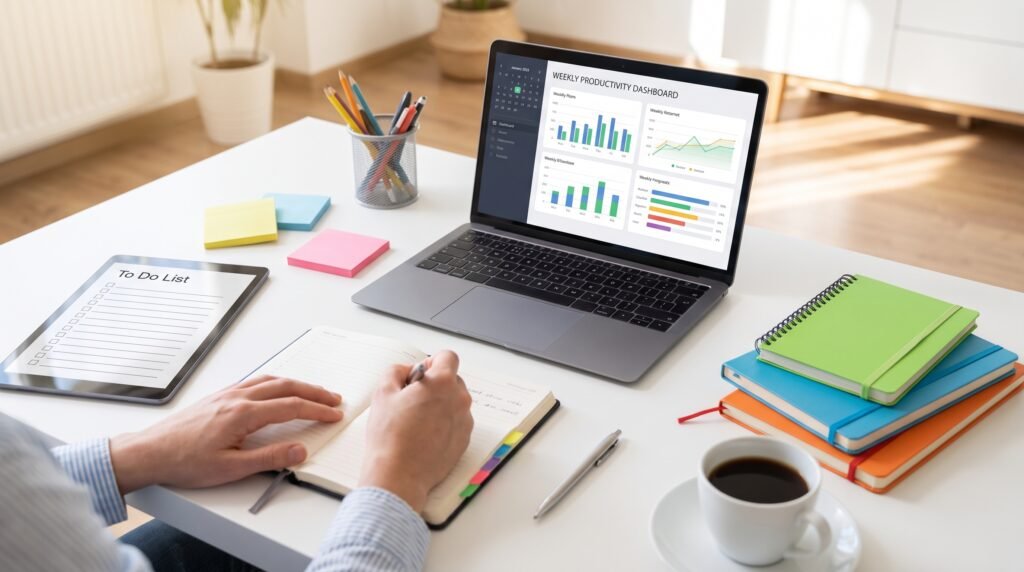
Picture this: your calendar is color-coded, your tasks are prioritized, your to-do list is broken into neat 30-minute blocks, and you’ve even downloaded the productivity app everyone’s talking about. On paper, you are crushing it. And yet, by 2 PM, you feel like you’ve been awake for three days straight. Your coffee has gone cold, your cursor is blinking at a half-written email, and the most cognitively demanding thing you can manage is scrolling through your phone.
Sound familiar? If it does, here’s the thing — and this might sting a little — your problem isn’t your schedule. It’s your energy.
Most of us were taught to treat time like the ultimate resource. Manage your time well, the thinking goes, and you’ll manage your life well. But what nobody tells you is this: time is fixed, energy is renewable. And when you start managing the latter, everything changes.
In this article, we’re going to dig into why energy management beats time management as a productivity strategy, how to spot the warning signs that you’re running on empty, and — most importantly — give you practical, real-world energy management tips you can start using this week.
- The Problem With Time Management (That Nobody Talks About)
- What Is Energy Management? (And Why It Changes Everything)
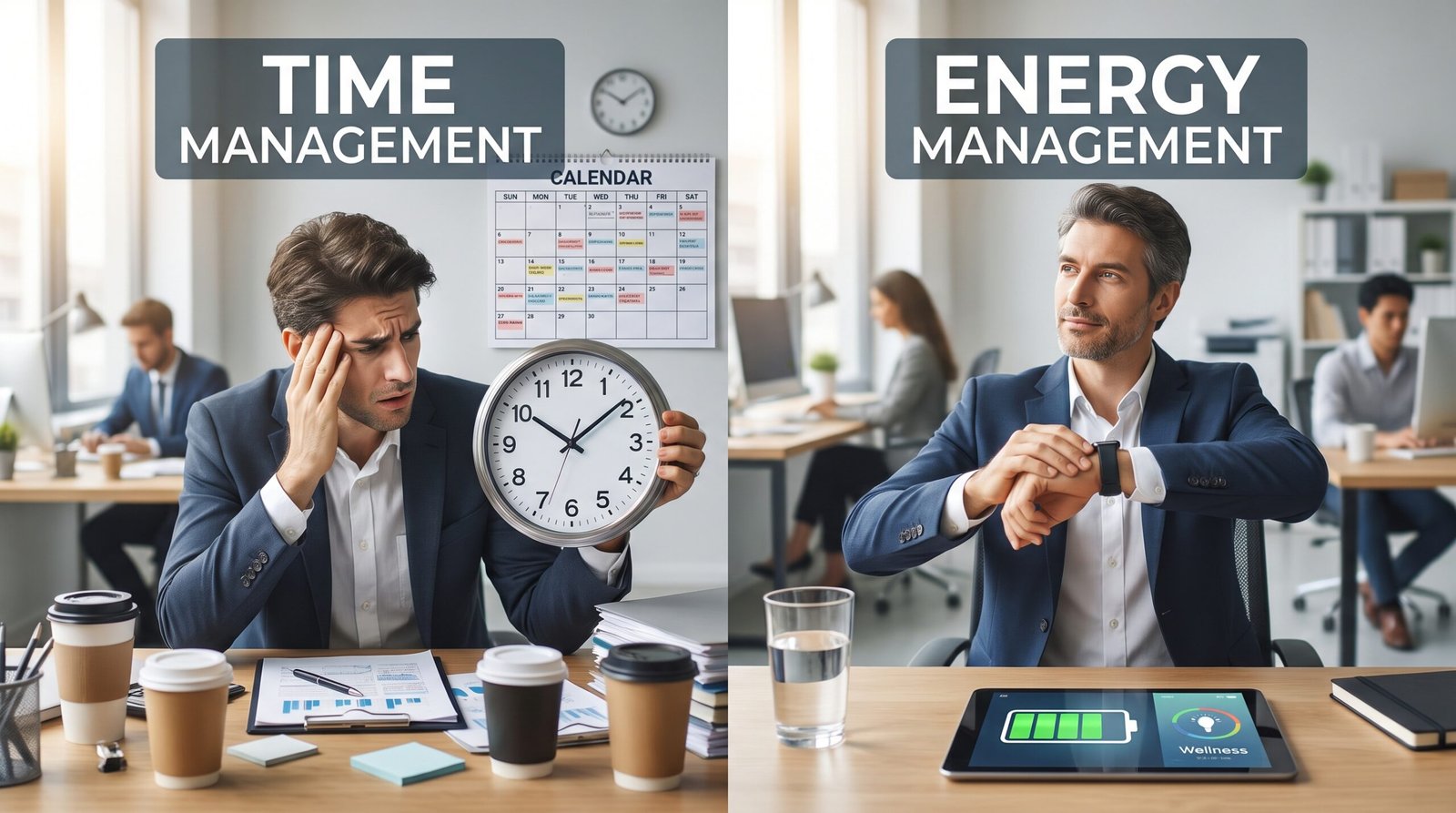
- Energy Management vs Time Management: A Head-to-Head Comparison
- Signs You're Managing Time But Ignoring Energy
- Practical Energy Management Tips to Implement This Week
- How to Combine Both: A Smarter Productivity Framework
- Final Thoughts
- Frequently Asked Questions
The Problem With Time Management (That Nobody Talks About)
Time management isn’t a bad idea. Let’s be clear about that. But it is a limited one — and the limits matter far more than most productivity gurus are willing to admit.
Here’s a bit of history worth knowing: time management as a formal discipline emerged during the Industrial Revolution. It was designed to track factory workers’ output — people whose work was largely physical, repetitive, and measurable by units per hour. Clock in. Clock out. Count the widgets. It made total sense in that context.
But you’re probably not a factory worker. You’re a knowledge worker — someone whose best output depends on creativity, problem-solving, focus, and judgment. And here’s the uncomfortable truth: 60 minutes of exhausted, depleted thinking is not the same as 60 minutes of sharp, energized thinking. Not even close. The math of time management completely breaks down when the quality of the hour isn’t accounted for.
Think about the advice to “just wake up earlier.” More hours should mean more output, right? Not if those extra hours are being powered by a brain running on five hours of sleep and sheer willpower. Hustle culture loves to ignore this inconvenient detail.
As Tony Schwartz and Jim Loehr argued in The Power of Full Engagement, human performance is ultimately grounded in the management of energy, not time. Time is the stage. But energy is the performance that happens on it. Manage your time perfectly and ignore your energy, and you’ll find yourself hitting your mark on an empty tank, every single day.
So if time isn’t the real currency of high performance — what is?
What Is Energy Management? (And Why It Changes Everything)
Energy management is the intentional practice of protecting, replenishing, and strategically deploying your energy — across four distinct dimensions — so that you can consistently perform at your best without burning yourself into the ground.
Those four dimensions are:
- Physical energy — the foundation of everything. Sleep, nutrition, movement, and recovery. Without this, the other three buckle.
- Mental energy — your capacity for focus, deep thinking, and decision-making. This is the one most knowledge workers drain first and replenish last.
- Emotional energy — how stress, relationships, and psychological safety affect your capacity to do meaningful work. A difficult conversation can wipe out your mental clarity for hours.
- Purposeful energy — sometimes called “spiritual” energy in performance science, this refers to your sense of meaning, alignment, and motivation. When your work feels meaningless, even full physical and mental energy won’t save you.
Here’s what makes energy management fundamentally different from “just taking breaks.” Breaks are reactive — you take one when you’re already depleted. Energy management is proactive. It’s a system built around understanding when your energy peaks, when it dips, and structuring your day around those rhythms rather than fighting them.
And there’s solid science behind this. Researcher Nathaniel Kleitman — the same scientist who discovered REM sleep — also identified what are called ultradian rhythms: natural 90-minute cycles your brain moves through throughout the day. About every 90 minutes, your body signals that it needs a recovery period. Most of us override that signal with caffeine, willpower, or sheer stubbornness. We pay for it by 3 PM, when coherent thought starts to feel like a luxury.
Energy Management vs Time Management: A Head-to-Head Comparison
Let’s put both approaches side by side so the difference is crystal clear.
| Time Management | Energy Management | |
| Core resource | Hours in a day | Physical, mental, and emotional energy |
| Core approach | Schedule and optimize tasks | Align tasks to energy levels |
| Key limitation | Fixed — 24 hours, no exceptions | Renewable and expandable with right habits |
| Primary risk | Over-scheduling, rigidity, burnout | Poor recovery, ignoring warning signs |
| Best suited for | Logistics, deadlines, meetings | Deep work, creativity, strategic thinking |
| Measures success by | Tasks completed, hours filled | Quality of output, sustained performance |
Now here’s a thought experiment worth sitting with. Imagine two versions of yourself completing the same task — let’s say writing a strategy document. Both versions have exactly the same 90-minute time block scheduled. One version starts after a full night of sleep, a short walk, and no back-to-back meetings all morning. The other starts after four hours of sleep, three consecutive video calls, and a lunch eaten while checking email.
Same time block. Radically different output. Same task, completely different energy.
Great time managers get things done. Great energy managers get the right things done well — consistently, sustainably, and without running themselves into the ground in the process.
The other critical idea here is peak energy windows: the specific times of day when your brain is operating at its sharpest. For most people, this window falls in the first 2–3 hours after waking. And what do most people do with that window? Email. Slack messages. The least cognitively demanding, most reactive work they do all day. That’s like warming up your best athlete only to have them sit on the bench during the first quarter.
Signs You’re Managing Time But Ignoring Energy
Before we get to solutions, let’s make sure you can recognize the problem. Here are the telltale signs that you’ve been laser-focused on your schedule while quietly ignoring your energy:
- You feel productive on paper but exhausted in reality. Your task list gets ticked off, but you end each day feeling wrung out rather than accomplished.
- Your mornings go straight to reactive work. Email, Slack, news, social media — someone else’s agenda is consuming your sharpest hours.
- You treat caffeine as a substitute for recovery. Coffee is a tool; dependency on it to push through slumps is a sign your energy rhythm is broken.
- You schedule deep work back-to-back with no buffer. Creative and cognitive tasks need runway before and after them. Without it, you’re asking your brain to sprint without stretching.
- Weekends feel like survival, not restoration. If you’re spending Saturday in recovery mode just to be functional on Monday, the weekly energy equation isn’t working.
- You end the day with a finished to-do list but no sense of meaningful progress. This is the one that should really make you pause. Busyness is not the same as impact — and energy management is what creates the difference.
If two or more of these felt uncomfortably accurate, that’s actually good news. It means the fix is conceptual, not circumstantial. You don’t need a new job. You need a new lens.
Practical Energy Management Tips to Implement This Week
Here’s the part you came for — and I promise, none of these require a 5 AM cold plunge or a two-hour morning routine. These are practical, grounded energy management tips designed to work inside the real life you already have.
Tip 1: Map Your Energy, Not Just Your Calendar
Before you can optimize anything, you need data. For the next five to seven days, rate your energy level once per hour on a simple 1–5 scale. Just a number in a notes app is enough. Do this honestly, without judging the results.
By the end of the week, you’ll have a personal energy map — a clear picture of when you’re sharp, when you’re fading, and when you’ve hit your floor. Then assign your task types accordingly: complex, creative, or strategic work goes into your peak windows; email, admin, and routine tasks go into your low-energy troughs. This one shift alone can transform your output without touching your total working hours.
Tip 2: Protect Your Peak Hours Like a Meeting You Can’t Cancel
Most people’s sharpest window is within 90 minutes to two hours of waking. This is when cortisol is naturally elevated, focus is cleanest, and creative bandwidth is widest. It’s your most valuable professional asset — and most people give it away for free by defaulting to the inbox.
Starting tomorrow: for the first 60–90 minutes of your workday, do not open your email or messaging apps. Use that time exclusively for your one highest-leverage task. Treat it as a non-negotiable appointment. This is arguably the single highest-ROI energy management tip in this entire article.
Tip 3: Work in Ultradian Rhythms (90-Minute Focus Cycles)
Remember Kleitman’s research on natural 90-minute focus cycles? Here’s how to put it to work. Structure your deep work sessions to last no longer than 90 minutes, then take a genuine 15–20 minute break — one that doesn’t involve screens or decision-making. A short walk, some music, a few minutes outside.
Fighting the recovery urge doesn’t save time — it borrows against the next cycle’s quality. You’re not being lazy when you step away. You’re making your next 90 minutes significantly more valuable.
Tip 4: Manage Decision Fatigue Deliberately
Decision fatigue is a real, well-documented phenomenon. Every decision you make — no matter how small — draws from the same pool of mental energy. By the time you’ve chosen what to wear, what to eat for breakfast, how to respond to a borderline email, and which meeting to reschedule, you’ve already spent cognitive capital that could have gone toward something that matters.
The fix: reduce low-stakes decisions wherever possible. Meal prep, a simplified wardrobe, default meeting formats, and templated email responses are all legitimate energy management tools. Batch similar decisions together. The mental energy you preserve will show up in the quality of your high-stakes thinking.
Tip 5: Treat Recovery as Part of the Work
This one requires a genuine mindset shift: rest is not the opposite of productivity. It is the prerequisite for it. Recovery is not a reward you earn by working hard enough — it’s the mechanism that makes the next round of work possible.
Short-form recovery during the workday looks like: a 10-minute walk between tasks, a few minutes of focused breathing, a lunch break spent away from your desk. Strategic recovery — the kind that actually resets your system — means prioritizing sleep quality, taking at least one full “off” day per week where you genuinely disconnect, and recognizing that leisure isn’t wasted time. It’s infrastructure.
Tip 6: Align Your Emotional and Social Energy
Not all meetings drain you equally. Not all conversations leave you in the same place. Some interactions replenish you — a check-in with a trusted colleague, a brief conversation that sparks an idea, a moment of genuine connection. Others cost you — a tense negotiation, a session of delivering difficult feedback, conflict that goes unresolved.
Start paying attention to this. Notice which interactions leave you energized and which leave you depleted. Then, where you have agency, batch emotionally demanding conversations during your most resilient windows — usually mid-morning, after your peak deep-work block — rather than scheduling them first thing or late in the afternoon when your reserves are lowest.
How to Combine Both: A Smarter Productivity Framework
Here’s the nuance that often gets lost in the energy vs. time management conversation: this isn’t an either/or choice. The strongest productivity systems use time management as the container and energy management as the fuel. You need both. The key is knowing which one to optimize first.
The approach is called Energy-First Scheduling, and it works like this:
- Start with your energy map. Before opening your calendar for the week, identify your peak, secondary, and low-energy windows based on the patterns you’ve tracked.
- Assign work types to energy levels. Deep work, strategic thinking, and creative output → peak windows. Meetings, email, admin → troughs.
- Then fill in the time blocks. Use conventional time management tools — time blocking, task batching, scheduling — but only after the energy architecture is set.
- Build in recovery buffers. Every two to three hours of high-intensity work should be followed by intentional recovery. Schedule these as seriously as any other commitment.
A simple weekly reset ritual helps maintain this: each Sunday evening or Monday morning, take five minutes to ask yourself three questions — When do I have the most energy this week? What are the two or three highest-leverage things I need to do? When will I recover? — before you touch your calendar.
The key mindset shift that makes all of this work is moving from “Do I have time for this?” to “Do I have the energy to do this well?” That single reframe will change how you plan, how you commit, and ultimately, how you perform.
Final Thoughts
Let’s come back to where we started — that version of you with a color-coded calendar, a flawless schedule, and absolutely nothing left in the tank by mid-afternoon. Now you know what was actually wrong. It wasn’t the calendar. It wasn’t the system. It was that the system was built entirely around time, while energy — the thing that actually determines the quality of everything you do — was left completely unmanaged.
Time is the stage. Energy is the performance. And you can have the most beautifully designed stage in the world; if the performer is exhausted, the show will suffer.
The good news is you don’t have to overhaul your entire life to start seeing results. Pick one energy management tip from this article — just one — and try it consistently for the next two weeks. Map your energy. Protect your peak hours. Build recovery into your day as seriously as you build in meetings. Small shifts in how you manage your energy create compounding improvements in the quality of everything you produce.
The goal was never to do more with less. The goal was always to do your best work — consistently, sustainably, and without burning out in the process. Energy management is how you get there.