You know that one task. The one that’s been sitting on your to-do list for three days straight. The one you mentally acknowledge every morning, quietly negotiate with yourself over, and then conveniently decide to “get to later” — except later never quite arrives.
Instead, you answer emails. You reorganize your desktop folders. You handle the smaller, safer, easier things that feel like productivity but aren’t really moving the needle. And by the end of the day, that task is still there — heavier than before, now carrying the added weight of guilt and the silent promise that tomorrow will be different.
Here’s the uncomfortable truth: the task you’re avoiding is almost always the most important one. And every hour you spend sidestepping it isn’t just wasted time — it’s wasted mental energy. That invisible weight follows you around all day, quietly draining your focus, your confidence, and your sense of real accomplishment.
That’s exactly what the Eat the Frog Method is designed to fix.
In this article, you’ll learn what the method actually is, where it came from, and the science that explains why it works so reliably. You’ll also get a practical, step-by-step system for identifying your frog correctly and implementing the habit daily — even if you’re not a morning person, even if your job is demanding, and even if you’ve tried every productivity framework before and fallen off the wagon.
By the end, you won’t just understand the concept. You’ll know exactly what to do with it, starting tonight.
- What Is the Eat the Frog Method?
- The Psychology and Science Behind It
- How to Identify Your Frog
- How to Apply the Eat the Frog Method Daily
- Who Benefits Most from the Eat the Frog Method?
- Eat the Frog vs. Other Productivity Methods
- Common Mistakes That Sabotage the Method
- Real-World Examples and Stories
- Final Thoughts
- Frequently Asked Questions
What Is the Eat the Frog Method?
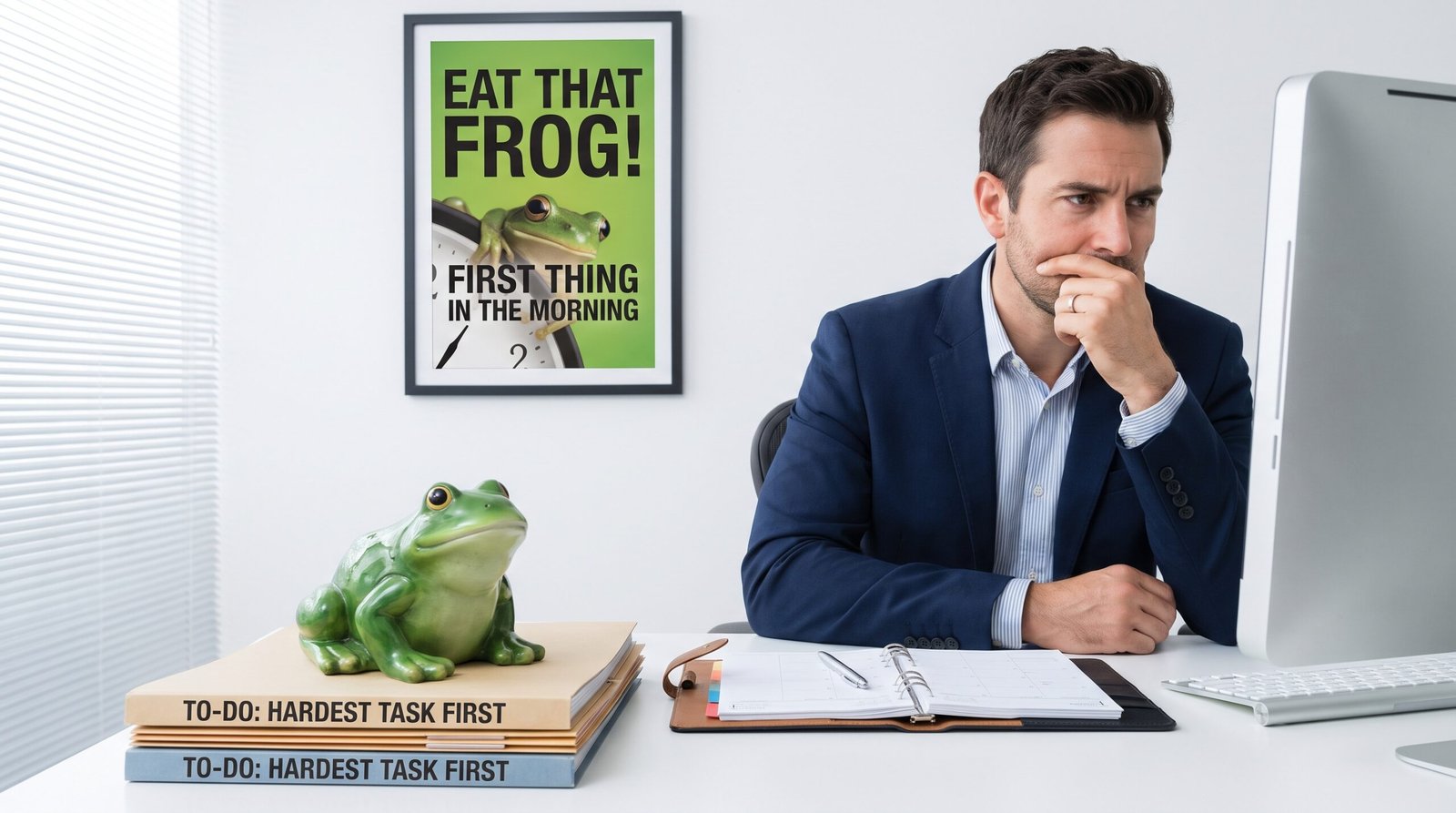
At its core, the Eat the Frog Method is a productivity strategy built around a single, deceptively simple principle: identify the one task you’re most likely to procrastinate on — the one that feels heavy, uncomfortable, or intimidating — and do it first, before anything else competes for your attention.
The phrase traces back to a quote most commonly attributed to Mark Twain: “If it’s your job to eat a frog, it’s best to do it first thing in the morning. And if it’s your job to eat two frogs, it’s best to eat the biggest one first.”
Worth noting: there’s genuine historical debate about whether Twain actually coined this line. Some researchers attribute an early version of it to French writer Nicolas Chamfort. But wherever the quote originated, the wisdom landed — and it stuck hard.
The concept was formalized into a complete productivity system by Brian Tracy in his 2001 bestseller Eat That Frog! 21 Great Ways to Stop Procrastinating and Get More Done in Less Time. Tracy’s framework turned a memorable one-liner into a daily operating system, and it has been a cornerstone of high-performance culture for the two-plus decades since.
But here’s where most people misread the method: the frog isn’t necessarily your longest task, and it isn’t your most urgent one either. It’s the task you have the strongest emotional resistance to. The one that makes your stomach drop just a little when you think about starting it. That specific unease — that low-level dread — is exactly what marks a task as your frog.
The frog is defined by avoidance, not difficulty. That distinction changes everything about how you approach this method — and why it works when other frameworks fall short.
The Psychology and Science Behind It
The Eat the Frog Method isn’t motivational folklore dressed up in productivity language. The reason it works as reliably as it does is grounded in real, well-researched cognitive science. Understanding the why makes you far more likely to stick with it.
Willpower Depletion and Decision Fatigue
Psychologist Roy Baumeister’s influential research on ego depletion established something that felt counterintuitive when first published: willpower is a finite daily resource. Every decision you make — no matter how trivial — draws from the same limited mental reservoir. By the time you’ve navigated a morning commute, scanned your inbox, answered three quick questions, and sat through a status meeting, you’ve already spent a significant portion of your cognitive fuel.
This is why the hardest tasks always feel harder in the afternoon. It isn’t laziness. It isn’t weakness. It’s biology — your brain operating on a depleted tank.
The Eat the Frog Method works in part because it places your most important work at the front of the day, when your willpower and decision-making energy are at their peak. You’re not fighting your frog at a disadvantage — you’re meeting it at full strength.
The Zeigarnik Effect: Why Avoidance Is Exhausting
Here’s something psychologists have understood since the 1920s that most productivity advice completely ignores: your brain refuses to quietly let go of unfinished tasks. This phenomenon — the Zeigarnik Effect, named for researcher Bluma Zeigarnik — means that incomplete tasks remain active in a kind of mental background loop, quietly consuming cognitive resources even when you’re not consciously thinking about them.
That low-level dread you carry when you haven’t started something important? That’s not just emotional discomfort. That’s your brain burning real processing power to keep an open loop alive.
When you eat your frog, you close the loop. The mental relief that follows isn’t simply psychological satisfaction — it’s a genuine cognitive unburdening that frees up working memory and focus for everything else in your day.
Dopamine and the Momentum Effect
There’s a third layer to this, and it might be the most motivating piece. Completing a genuinely challenging task early in the day triggers a dopamine release — the brain’s core reward and motivation signal. That dopamine hit doesn’t just feel good in the moment; it creates forward momentum.
Psychologists sometimes refer to this as a “success cascade.” One meaningful win in the morning primes your brain to keep pursuing wins. The confidence and elevated energy you carry after eating your frog aren’t imaginary — they’re neurochemical.
Put it all together and the picture becomes clear: the Eat the Frog Method isn’t just a time management technique. It’s a neurological reset button for your entire day.
How to Identify Your Frog
This is where many well-intentioned people stumble. They love the concept, adopt the label, and then consistently misidentify their frog — which means building the right habit around the wrong task and wondering why nothing changes. Here’s a four-step process for getting it right.
Step 1: Ask the Uncomfortable Question
Start here: “What is the one task that, if I completed it today, would make the biggest positive difference — and that I’m most tempted to find reasons to avoid?”
Not the most pressing item in your inbox. Not the thing your manager mentioned twice. The task that quietly sits at the back of your mind, that you’ve been meaning to start, that you know matters — and that you keep finding creative reasons to delay.
Step 2: Apply the Three-D Filter
Run your candidate task through three quick questions:
- Dread — Does thinking about starting it create any form of resistance or low-level anxiety?
- Delay — Have you been pushing it back for more than two days?
- Impact — Would completing it meaningfully move a goal forward that genuinely matters to you?
If all three answers are yes, you’ve found your frog. No further deliberation needed.
Step 3: Write It Down the Night Before
This step is chronically underrated and quietly essential. Don’t try to identify your frog in the morning. Decision fatigue begins the moment you wake up, and spending cognitive energy at the start of your day figuring out what to tackle first is exactly the kind of unnecessary drain you’re trying to eliminate.
The night before, write one sentence: “Tomorrow, my frog is ___.” That’s the entire ritual. This simple act primes your subconscious overnight, removes all morning ambiguity, and makes it dramatically easier to begin without negotiating with yourself first.
Step 4: Rank Your Tadpoles
Once the frog is identified, identify two or three tadpoles — smaller, related tasks that support or naturally follow from the main one. If you finish your frog (and you will, more often than you expect), tackle the tadpoles next. The goal is to replace the frog’s slot with meaningful work, not to celebrate completion by drifting into busywork.
How to Apply the Eat the Frog Method Daily
Knowing what the method is and actually building it into your daily life are two different challenges. Here’s a practical five-step implementation system.
Step 1: Protect the First 60–90 Minutes of Your Day
This window is sacred. No email. No Slack notifications. No social media scroll “just to wake up the brain.” Your peak cognitive hours are too valuable to spend on other people’s priorities and other people’s urgencies.
If your job requires some level of morning responsiveness, try a strict 15-minute triage window at the start of your day — enough time to scan for genuine emergencies without getting pulled into the full reactive spiral. The rule is simple: you can look, but you cannot respond until the frog is done.
Step 2: Eliminate Environmental Friction in Advance
Prepare your workspace the night before specifically for the frog task. If your frog involves writing, have the document open. If it’s a difficult call, have the contact pulled up. If you need a distraction-free digital environment, configure your website blockers before you go to sleep.
Research from Gloria Mark at UC Irvine found that after a digital interruption, it takes an average of 23 minutes to return to full, deep focus. A single notification can unravel an entire frog session. Don’t leave this to willpower in the moment — design the environment the evening before.
Step 3: Use a Time Container, Not Just a To-Do List
Writing your frog on a to-do list is the minimum viable commitment. Blocking dedicated, specific time for it on your calendar is where the intention becomes real. Treat it exactly like an unmovable meeting — because it is one: a standing appointment with the version of yourself you’re actively working to become.
Depending on the nature of your task, block between 25 and 90 minutes. You don’t need to finish in one sitting. You need to start and sustain focused attention long enough to break through the initial resistance.
Step 4: Start Ugly
Perfectionism is one of the most common — and most disguised — reasons people avoid their frog. The task feels important enough that starting with anything less than a perfect first attempt feels like preemptive failure.
Grant yourself explicit permission to produce a rough, imperfect, messy beginning. The goal of your first frog session isn’t completion — it’s breaking inertia. An ugly first draft outperforms a perfect blank page every single time. A rough outline beats endless planning. Getting your hands into the actual work is what matters.
Step 5: Celebrate the Completion
When you finish your frog — or make substantial progress — acknowledge it. Tell someone, mark it in a journal, cross it off visibly, or simply take 60 seconds to sit with the fact that you did the hard thing. This isn’t self-indulgence. It actively reinforces the neural pathway that makes tomorrow’s frog session a little easier, gradually building a genuine habit rather than a daily act of brute willpower.
Who Benefits Most from the Eat the Frog Method?
The short answer is: almost everyone. But the method delivers particularly powerful results for certain types of people.
Chronic procrastinators find it transformative not because it eliminates the avoidance instinct, but because it gives that instinct a specific, structured moment to push against. Knowing your frog is already identified and time-blocked removes the ongoing moment-to-moment negotiation that procrastination thrives within.
Entrepreneurs and freelancers, who operate without external accountability structures, often name the Eat the Frog Method as the single habit that most reliably prevents entire days from disappearing into low-value busywork while the important projects quietly wait.
Knowledge workers — writers, developers, analysts, designers — whose most valuable output requires sustained deep focus stand to gain enormously from protecting their sharpest cognitive hours for their hardest creative and intellectual work.
Students find it particularly effective for long-term projects and exam preparation, where the gap between “when I should realistically start” and “when I actually start” is painfully, universally familiar.
That said, the method isn’t one-size-fits-all in its execution. Night owls whose genuine cognitive peak arrives in the evening can absolutely apply this principle — it just won’t look like a 7 AM ritual. Parents of young children whose mornings are joyfully chaotic can find their version of the sacred window later in the day. The principle scales to your actual life: “first” doesn’t mean 8 AM. It means before anything unimportant.
Eat the Frog vs. Other Productivity Methods
The productivity landscape is crowded with frameworks, systems, and philosophies. Here’s where the Eat the Frog Method sits relative to the most popular alternatives:
| Method | Core Idea | Best For |
| Eat the Frog | Do the hardest, most-avoided task first | Procrastination & deep work |
| Time Blocking | Schedule every hour of your day | Structure-driven workers |
| Pomodoro Technique | Work in 25-minute focused sprints | Attention & focus management |
| Getting Things Done (GTD) | Capture and systematically organize everything | High-volume task managers |
| Ivy Lee Method | Rank 6 daily priorities the night before | Simplicity-seekers |
Eat the Frog pairs exceptionally well with both Time Blocking and the Ivy Lee Method. A seamless combination: use the Ivy Lee Method to rank your six most important tasks the night before, identify which one is your frog, then use Time Blocking to defend the morning window for it.
The deeper takeaway: most productivity systems tell you how to work. The Eat the Frog Method tells you what to work on first. That’s a fundamentally different layer of the problem — which is exactly why so many people can feel organized yet still unproductive. They’ve built systems for managing tasks. They haven’t built a system for prioritizing the ones that require courage.
Common Mistakes That Sabotage the Method
Even enthusiastic adopters find the method quietly unraveling after the first week or two. Here’s why — and how to course-correct.
Choosing the wrong frog is the most common and most consequential error. Picking the longest or most time-sensitive task rather than the most emotionally avoided one means you’re front-loading your schedule without addressing the actual procrastination pattern underneath.
Eating two frogs simultaneously by splitting your focus between two major tasks dilutes the cognitive benefits of both. One frog. Complete, undivided attention. The method’s power comes from concentration, not multitasking.
Letting the warm-up become avoidance is subtle and surprisingly common. “I’ll just check email for five minutes first to get into the right headspace” is how frogs escape. Without a firm starting intention, a warm-up ritual becomes a 45-minute avoidance spiral that feels nothing like avoidance while it’s happening.
Skipping the night-before identification step means arriving at your morning with no clarity, which means spending your peak cognitive hours deciding what to do instead of doing it.
Treating it as all-or-nothing is what ends most new habits. Missing a day isn’t failure — it’s a Tuesday. Consistency over time matters more than perfection in any given week.
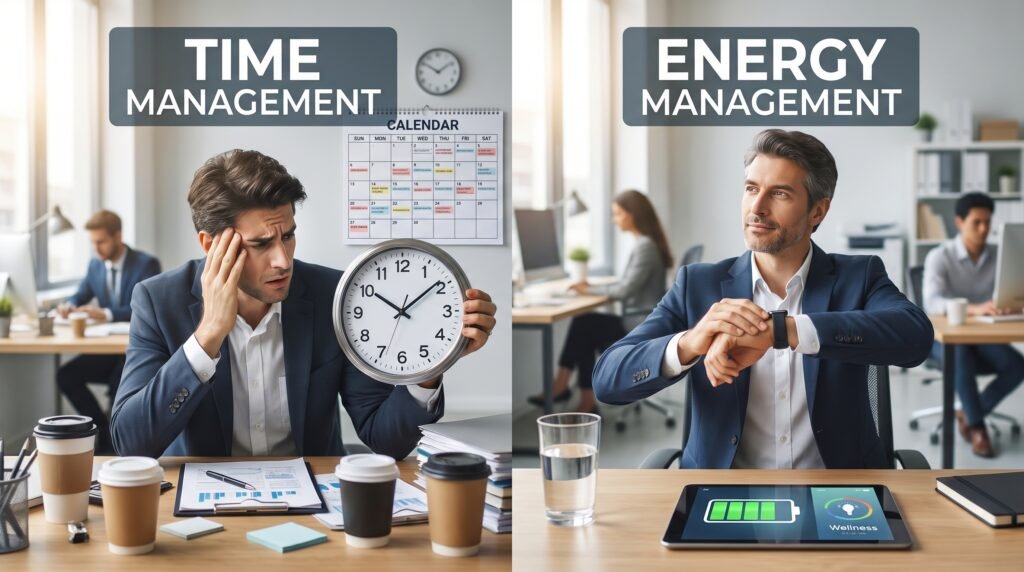
Ignoring energy, not just time is a mistake even experienced practitioners make. A badly depleted, sleep-deprived morning is not automatically better than an energized early afternoon. Honor your biology. Apply the principle intelligently, not rigidly.
Real-World Examples and Stories
The stories people tell about this method tend to follow the same shape, even when the frogs themselves are completely different.
There’s the freelance writer with a book proposal that’s been “almost ready” for six weeks, who spends each day doing everything except writing it — client emails, research rabbit holes, productivity blog posts — until one morning they open the document before anything else and produce 400 imperfect words. Not good words. Just words on a page. But starting broke the spell, and the proposal is submitted three weeks later.
There’s the sales professional who knows from experience that their numbers improve significantly when they make cold calls first thing in the morning, but who keeps arriving at the phone already emotionally depleted from an hour of admin work. The week they reverse the order — calls first, everything else after — their close rate climbs noticeably. The calls didn’t get easier. They just got better fuel.
There’s the university student who always saved their most-dreaded subject for last, after hours of easier material, and couldn’t understand why it never seemed to stick. Flipping the sequence — hardest subject first, while focus was freshest — changed their results within a single semester.
The details differ widely. The underlying pattern is identical in every version. The frog is always the thing you’ve been quietly running from. And eating it first is always the thing that reframes the entire day.
Final Thoughts
The Eat the Frog Method has been around in various forms for decades, but it resonates as strongly today as it ever has — possibly more so, in a world architecturally designed to fragment your attention, fill your mornings with other people’s urgencies, and make reactive busyness feel indistinguishable from real progress.
What makes it enduringly powerful isn’t complexity. It’s honesty. The method asks you to look at your task list not through the lens of urgency or efficiency, but through the lens of avoidance. What are you running from? Start there.
The science supports it clearly: willpower depletes, open loops drain focus, and early wins create momentum. But the method also works on a more human, more fundamental level. There is something genuinely transformative about facing the thing that intimidates you first — before the day has had a chance to chip away at your energy, your confidence, and your resolve.
Your frog isn’t just a task. It’s the thing standing between you and the version of yourself you’re actively working to become.
So tonight, before you close your laptop or set down your phone, write down your frog for tomorrow. Just one. Keep it specific, keep it honest, and see what changes when you meet it head-on before anything else gets a say.
The day that becomes a consistent habit is the day your relationship with your own potential shifts — quietly, permanently, and for good.