Here’s a scenario that might feel uncomfortably familiar.
You sit down at your desk at 9am with big intentions. By noon, you’ve answered seventeen emails, attended two meetings, scrolled LinkedIn “just for a minute,” replied to a chain of Slack messages, and reorganized your task list twice. You feel like you’ve been working hard. But when someone asks you what you actually accomplished? You struggle to point to anything.
That gap — between feeling busy and actually being productive — is exactly what the right deep work techniques are designed to close.
Deep work is the ability to focus without distraction on cognitively demanding tasks. It’s where your best thinking happens, your hardest problems get solved, and your most meaningful output gets created. And the irony is that most people rarely get to experience it — not because they’re lazy or undisciplined, but because nobody ever taught them how.
This guide changes that. You’ll find seven practical deep work techniques you can start using this week, along with the science behind why they work, the most common mistakes that quietly derail people, and a simple 30-day plan to build your own deep work practice from scratch.
- What Exactly Is Deep Work (And Why Most People Have It Backward)
- The Neuroscience That Makes Deep Work So Powerful
- The 4 Deep Work Philosophies — Find the One That Fits Your Life
- 7 Proven Deep Work Techniques to Start Using This Week
- The Environment Equation — Setting Up for Deep Work Success
- Why Your Deep Work Keeps Getting Derailed (And How to Fix It)
- How to Build Your Deep Work Practice Over 30 Days
- Final Thoughts
- Frequently Asked Questions
What Exactly Is Deep Work (And Why Most People Have It Backward)
Deep work is professional activity performed in a state of distraction-free concentration that pushes your cognitive capabilities to their limit. It’s the kind of work that creates real, lasting value — the kind that builds genuine skill and produces output that can’t be easily replicated by someone who’s only half-present.
The contrast is shallow work: low-cognitive-demand tasks that are often urgent-feeling but rarely important. Email. Administrative requests. Most meetings. Status updates. These tasks aren’t inherently bad — they’re a real and necessary part of most jobs. The problem is when shallow work quietly colonizes all the time that was supposed to belong to deeper, more meaningful work.
Here’s the misconception that trips most people up: they assume that working long hours or feeling constantly busy equals working deeply. It doesn’t. You can spend ten hours at your desk doing almost entirely shallow work. And you can do three hours of genuine deep work and outproduce a colleague who clocked twelve.
What makes deep work particularly valuable right now is the timing. As automation and AI handle more routine cognitive tasks, the economic premium on truly high-quality human thinking — the work that requires sustained judgment, creativity, and problem-solving — keeps rising. Deep work isn’t just a productivity technique. It’s increasingly a professional differentiator that separates people who are busy from people who are genuinely indispensable.
The most useful reframe is this: deep work is a skill, not a fixed trait. It’s not something some people are born with and others aren’t. It degrades without practice and improves with deliberate training — which means it’s entirely within your control.
The Neuroscience That Makes Deep Work So Powerful
Understanding why deep work works at a biological level makes it much easier to stick with — because you stop experiencing the warm-up struggle as failure and start recognizing it as a normal part of the process.
When you sit down to do focused work, your brain needs to shift from its default mode network — the wandering, associative state that shows up during rest and mind-wandering — into the task-positive network, the system responsible for goal-directed attention. This transition takes time. Typically ten to twenty minutes. Every interruption resets the clock to zero.
This is the mechanism behind what researcher Sophie Leroy calls attention residue. When you switch from one task to another, mental fragments of the first task don’t vanish immediately. They linger in your working memory and compete with your attention on the new task. This is why checking your phone once during a deep work session costs you far more than the thirty seconds it takes — the attentional residue from that switch can impair your focus for twenty minutes afterward.
Then there’s myelin — the fatty sheath that wraps around neural pathways and speeds up signal transmission. Every time you practice a demanding skill with focused, sustained effort, the myelin layer thickens, making that neural circuit faster and more reliable. Deep work, applied consistently to a specific skill or domain, is a direct biological mechanism for building expertise. You’re literally rewiring your brain to be better at the thing you’re practicing.
Finally, there’s the relationship between deep work and flow — the state of effortless, absorbed concentration described by psychologist Mihaly Csikszentmihalyi. Flow doesn’t cause deep work. Deep work creates the conditions for flow. Distraction-free concentration, clear goals, and a challenge level slightly above your current ability are the preconditions flow needs to emerge. You can’t chase flow directly. You can only build the practice that makes it increasingly likely to show up.
The 4 Deep Work Philosophies — Find the One That Fits Your Life
Before reaching for specific techniques, you need a structural framework that fits your actual life — not an idealized version of it. There are four broad approaches to organizing your work around depth, each suited to different schedules and career types.
The Monastic Philosophy eliminates or radically reduces shallow obligations to preserve maximum cognitive bandwidth for deep work. This works well for independent writers, researchers, or solo founders who have significant control over their time. For most people in structured jobs, a full monastic approach isn’t realistic — but borrowing elements of it (like protecting a no-meeting day) is absolutely worth trying.
The Bimodal Philosophy divides your time into clearly defined deep and shallow periods — alternating between them in longer stretches, full days or even weeks at a time. An academic might spend four days a week in deep research mode and one day handling email, meetings, and admin. This requires scheduling flexibility but delivers impressive depth within the focused periods.
The Rhythmic Philosophy is the most accessible entry point for most working professionals. It means scheduling the same deep work block at the same time every day until it becomes as automatic as brushing your teeth. The consistency removes the daily decision of when to do deep work — which is itself a drain on willpower. If you’re just starting out, start here.
The Journalistic Philosophy involves fitting deep work into whatever gaps appear in your schedule — no fixed blocks, just rapid transitions into depth whenever windows open. This sounds flexible and appealing, but it requires significant prior experience with deep work. Jumping cold into genuine depth on demand is a skill that takes time to develop. It is not a beginner’s approach.
7 Proven Deep Work Techniques to Start Using This Week
Now for the practical part. These are the specific deep work techniques that consistently work — and more importantly, why they work.
1. Time Blocking — The Architecture of a Focused Day
Time blocking means assigning every hour of your workday a specific job in advance. Not just a to-do list — a scheduled block that owns a defined slot of time. Deep work blocks (60–90 minutes of undivided focus), shallow work blocks (email, admin, meetings), and buffer blocks (for overruns and transitions) each get their own time slot on your calendar.
The key rule: protect your deep blocks the way you’d protect a meeting with your most important client. Start with a single 90-minute deep work block per day — not four hours. One consistently protected block is worth far more than four aspirational hours that never materialize.
2. The Deep Work Ritual — Signal Your Brain It’s Time to Focus
Motivation is unreliable. Willpower is finite. A consistent pre-work ritual is neither. A ritual is a repeatable series of actions that signals to your brain that deep work is beginning — and over time, the ritual itself starts to carry you into focus before you’ve even sat down properly.
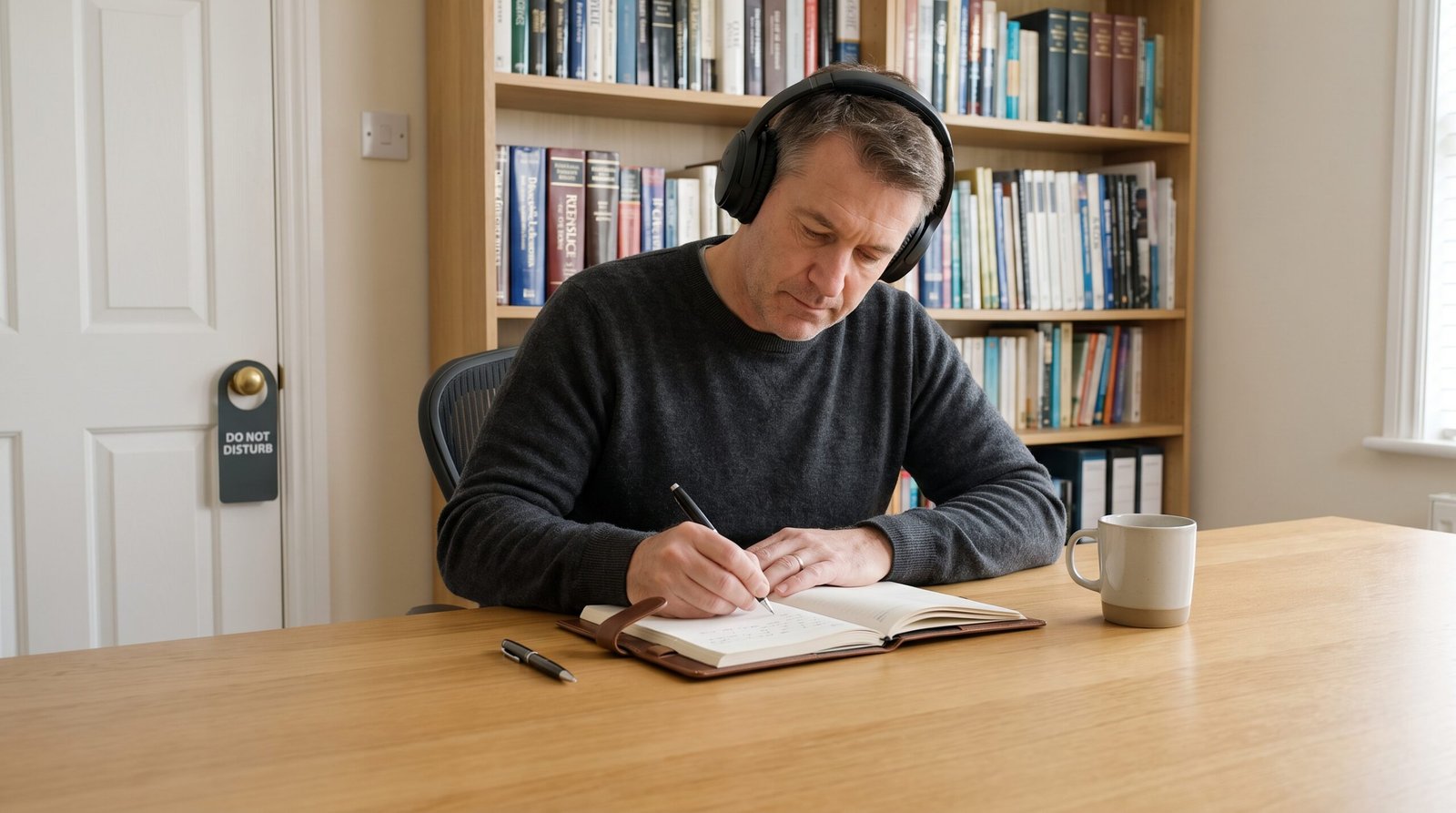
An effective ritual doesn’t need to be elaborate. It needs to be consistent. Make your specific drink. Put on instrumental music or your noise-canceling headphones. Write a single sentence stating what you’re working on and what a successful session looks like. Then start. The point is a repeatable on-ramp that removes the friction of getting started, so you’re not burning cognitive fuel just trying to begin.
3. The 90-Minute Session Rule — Working With Your Ultradian Rhythm
Human beings naturally cycle through high-alertness and recovery phases roughly every 90 to 120 minutes — a pattern called the ultradian rhythm. Your ability to sustain genuinely deep focus isn’t constant across the day; it peaks and dips in these biological cycles regardless of how much coffee you drink.
The most effective deep work sessions work with this rhythm rather than against it. Work intensely for 90 minutes. Then stop fully. Take a real break — a walk, a stretch, genuine quiet time — not a scroll through social media. Then assess whether you have another 90-minute block in you or whether you’ve hit your depth limit for the day. Most people max out at two to three quality sessions. That is enough. It is more than most people achieve in a full eight-hour day of scattered effort.
4. Productive Meditation — Training Your Focus Like a Muscle
This technique is consistently underrated, and it’s one that most productivity guides skip entirely. During physically active but mentally unoccupied time — a walk, a commute, a workout — deliberately focus your mind on a single professional problem. Not casually think about it. Actively work it. Notice when your mind wanders (it will, constantly at first), and bring it back without judgment.
No podcasts. No music. Just the problem and your thinking.
Done a few times a week, productive meditation builds raw attentional capacity over time. It’s a resistance training session for your focus — and it costs no extra time whatsoever, because you’re doing it during time that would otherwise be mentally idle. Over weeks, the effect on your deep work session quality is significant.
5. The Distraction Inventory — Know Your Specific Weaknesses
Generic advice says “eliminate distractions.” That’s about as useful as telling someone to “just try harder.” What actually works is knowing your specific distractions, because they’re different for everyone.
Audit your last five interrupted deep work sessions. What pulled you away? When in the session did it happen — early, mid-session, when stuck? Was it an external trigger (a notification, a colleague stopping by) or an internal one (boredom, restlessness, anxiety about something else on your to-do list)? Map your personal distraction profile and engineer specific solutions. If your weakness is reflexively opening a browser tab when you hit a mental wall, a website blocker addresses it. If it’s internal anxiety about an unrelated task, a pre-session brain dump clears the mental backlog before you start. Targeted solutions beat general rules every single time.
6. Depth Metrics — Measure What You Actually Want to Grow
You can’t improve what you don’t measure. Most people track time worked — but that’s a measure of quantity, not quality. Depth metrics track the actual output of your deep work: pages written, problems solved, features shipped, decisions made with full information.
Keep a simple daily scoreboard. Log how many hours of genuine deep work you completed and what the concrete output was. Track it weekly. Over time, the scoreboard reveals patterns — which days, times of day, and environmental conditions produce your best work, and which consistently underdeliver. This is how a deep work practice becomes data-informed rather than just aspirational.
7. The Shutdown Ritual — The Technique That Makes Tomorrow’s Deep Work Possible
Here’s an often-overlooked truth: how you end your workday directly determines the quality of your deep work the following day.
The shutdown ritual is a deliberate end-of-day process that formally closes the workday. Review your incomplete tasks. Capture every open loop in your system — a planner, a notes app, wherever you’ll actually look. Then say or write your shutdown phrase: “Shutdown complete.”
The neuroscience behind this is the Zeigarnik effect — the brain’s well-documented tendency to repeatedly return to unfinished tasks in the background. Open loops generate the intrusive thoughts that hijack your evenings, degrade your sleep quality, and leave you starting the next day’s deep work sessions already cognitively fatigued. A written plan tells the brain that the task is handled and quiets the loop. Without a shutdown ritual, your brain keeps working after you’ve stopped — and charges it all to tomorrow’s cognitive budget.
The Environment Equation — Setting Up for Deep Work Success
Your environment is never neutral. It’s either supporting your concentration or working against it — and often doing both simultaneously in ways you haven’t fully mapped.
On the physical side, a designated workspace matters more than most people expect. It doesn’t require a home office or a private room. Even a specific corner, a particular chair, or a consistent desk at a co-working space trains your brain to associate that location with focused work. Clutter increases cognitive load in ways that feel minor individually but accumulate across a session. Natural light and a comfortable temperature are basic environmental inputs that your focus depends on more than you’d likely estimate.
On the digital side, the single most impactful intervention most people can make is removing their phone from the room entirely during deep work blocks — not placing it face-down, not silencing it. Removing it. Research by Adrian Ward at the University of Texas found that even the visible presence of a smartphone (switched off, face-down on a desk) measurably reduces available cognitive capacity. The pull of potential distraction is enough to degrade performance, even when you never actually pick it up. Website blockers like Freedom or Cold Turkey handle the browser problem for people whose weakness is the reflexive new-tab reflex.
On the social side, protecting your deep work blocks requires communicating them. A simple message — “I’m heads-down from 9 to 11 and won’t be checking messages until then” — goes a long way when applied consistently. Colleagues, family, and housemates can’t respect a boundary they don’t know exists.
One genuinely underrated tactic: occasionally change your environment entirely. Working from a library, a quiet café, or an unfamiliar corner of a building can produce what researchers call a novelty effect — a temporary cognitive reset that measurably boosts creative and focused work. It’s not a daily strategy, but it’s a powerful tool when your usual environment starts feeling stale.
Why Your Deep Work Keeps Getting Derailed (And How to Fix It)
Most people who try deep work don’t fail because the approach doesn’t work. They fail because of a handful of predictable, fixable mistakes.
Starting with the wrong task. Beginning a deep work session with an easy win because it “builds momentum” is a form of sophisticated avoidance. Momentum is built by starting hard things — and the satisfaction of real progress on a genuinely difficult problem is far more energizing than the false warmth of clearing small tasks first. Identify your Most Important Task the night before and start there, every time, without negotiation.
Treating deep work as leftover time. When deep work is scheduled after all the reactive obligations are handled, it never happens. Reactive work expands to fill all available time — reliably, every single day. Schedule your deep work blocks first, before your calendar fills with requests and meetings, and protect them accordingly.
Confusing deep work with important-feeling busyness. Not every demanding task qualifies as deep work. Before starting a session, ask: does this task require sustained, undivided, cognitively stretching effort? If the honest answer is no, it belongs in a shallow block — not a protected deep work slot.
Expecting focus to arrive immediately. The first fifteen minutes of a deep work session often feel uncomfortable — restless, distracted, unfocused. Many people read this as evidence that deep work “isn’t working today” and abandon the session. This is the normal warm-up phase, not a signal to stop. The ritual bridges this gap, but some days the gap is longer. Sit with it.
Treating rest as wasted time. Deep mental work is physiologically costly. Cramming shallow tasks into every break, never fully disengaging between sessions, means showing up to the next block running on cognitive fumes. Recovery isn’t separate from the deep work system — it’s built into it by design.
How to Build Your Deep Work Practice Over 30 Days
The single biggest mistake people make when starting a deep work practice is trying to go from zero to four hours per day in a single week. That almost always fails — and leads to the conclusion that deep work “just doesn’t work for me.”
Build it the same way you’d build physical fitness: incrementally, with progressive overload, and with deliberate recovery built in.
Week 1: Introduce one 60-minute deep work block per day. The goal is not impressive output. The goal is showing up and completing the ritual. Don’t judge the quality of the session. Just build the habit of beginning.
Week 2: Extend the block to 90 minutes and add the shutdown ritual at the end of each workday. Begin tracking your depth metrics — even just a quick daily note of what you worked on and for how long. The act of measurement changes your relationship to the practice.
Week 3: On three days of the week, experiment with adding a second deep work block. Audit your environment and make the specific adjustments your distraction inventory identified. Begin trying productive meditation on walks or commutes.
Week 4: Review your depth metric logs from weeks one through three. Where was your output strongest? What conditions were in place on those days? Use these findings to customize your approach — your optimal schedule, your preferred environment, your best deep work philosophy — rather than following anyone else’s blueprint.
By Day 30, the goal isn’t perfection. It’s a personalized, repeatable system — one that fits your actual life, accounts for your specific weaknesses, and consistently produces better work than you were doing before you started.
Final Thoughts
In a world deliberately designed to fragment your attention — notifications, algorithmic feeds, open offices, always-on messaging culture — the ability to focus deeply on meaningful work is becoming one of the rarest and most consequential capabilities a professional can develop.
The deep work techniques in this article aren’t shortcuts or hacks. They’re deliberate practices that, applied with consistency over time, rebuild exactly what constant distraction erodes: your capacity to think clearly, create meaningfully, and produce work you’re genuinely proud of.
You don’t have to implement all seven techniques at once. Pick the one that resonates most with where you are right now. Start there. Not next Monday, not after the busy period passes — today.
Your attention is the most finite resource you have. These deep work techniques exist to help you spend it on things that are actually worth it.