Here’s an uncomfortable truth: you can work a 10-hour day and still get less done than someone who worked four. It’s not about hustle. It’s not about waking up at 5 a.m. or drinking green juice out of a mason jar. The real difference between people who consistently achieve big things and people who stay busy without moving the needle comes down to one thing — productivity habits.
High achievers aren’t superhuman. They don’t have more hours in the day than you do, and most of them will tell you they’ve failed at time management more times than they can count. What sets them apart is that they’ve stopped relying on motivation (which is unreliable) and started relying on systems (which aren’t). They’ve built a handful of repeatable habits that protect their focus, manage their energy, and remove the friction between “I should do this” and “I’m doing this.”
In this article, we’re skipping the generic advice you’ve read a hundred times. Instead, you’ll get 10 specific, research-backed productivity habits that top performers actually use — along with the psychology behind why they work and exactly how to start applying them today, even if you’ve never successfully kept a habit in your life.
- Why Productivity Habits Matter More Than Motivation
- Habit 1: They Protect a "Power Hour" Instead of Chasing Early Wake-Up Times
- Habit 2: They Single-Task Instead of Multitask
- Habit 3: They Time-Block Their Calendar Like It's Non-Negotiable
- Habit 4: They Manage Energy, Not Just Time
- Habit 5: They Have a Defined Shutdown Ritual
- Habit 6: They Say No Strategically
- Habit 7: They Batch Similar Tasks
- Habit 8: They Use the Two-Minute Rule
- Habit 9: They Run a Weekly Review
- Habit 10: They Engineer Their Environment for Focus
- How to Actually Build These Habits (Without Burning Out)
- Final Thoughts
- Frequently Asked Questions
Why Productivity Habits Matter More Than Motivation
Motivation is a feeling, and feelings are unreliable. It shows up when you’re inspired and disappears the moment you’re tired, stressed, or bored — which, let’s be honest, describes most Tuesday afternoons. If your ability to get things done depends on “feeling like it,” you’re setting yourself up to fail.
Productivity habits solve this problem by removing the decision entirely. A productivity habit is a repeatable daily system that reduces decision fatigue and protects your focus — it doesn’t rely on willpower or motivation to work. When something is a habit, you don’t have to talk yourself into it every single time. You just do it, the same way you don’t negotiate with yourself about brushing your teeth.
This is precisely why high achievers seem so consistent from the outside. It’s not that they’re more disciplined as people — it’s that they’ve engineered their days so discipline barely needs to show up.
Habit 1: They Protect a “Power Hour” Instead of Chasing Early Wake-Up Times
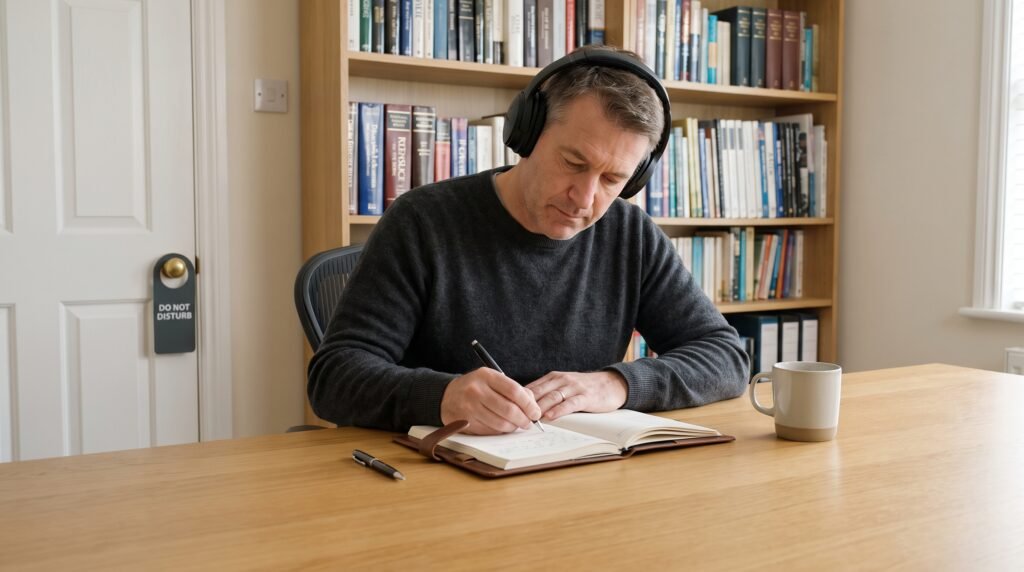
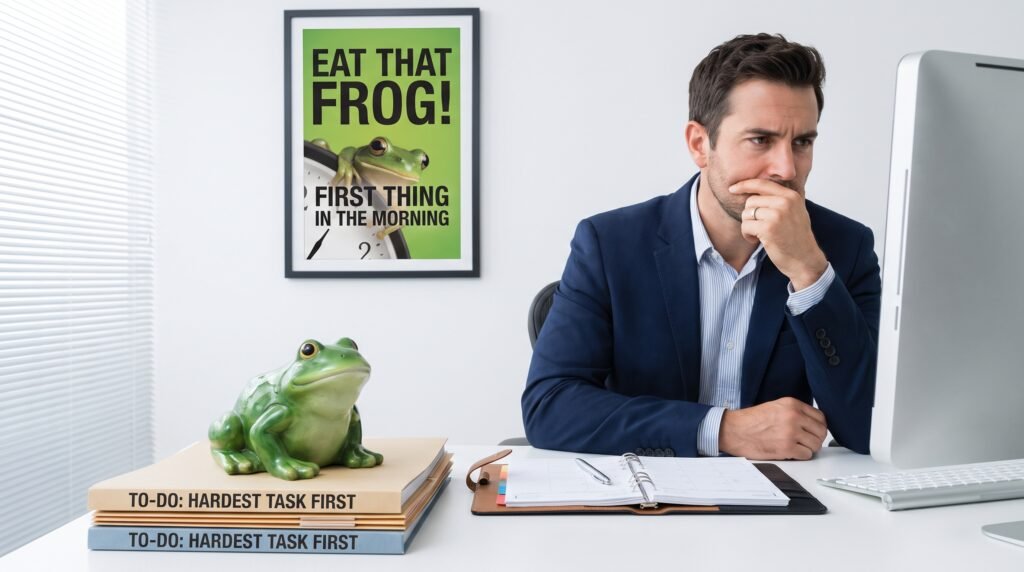
What it is: A dedicated, distraction-free block of time reserved for your single most important task — not just an early alarm for the sake of it.
Why it works: The “wake up at 5 a.m.” advice gets so much attention that people miss the actual point. What matters isn’t the hour on the clock — it’s having one uninterrupted stretch where your brain is fresh and nothing is allowed to interrupt it. Willpower and focus are finite resources that deplete as the day goes on, a concept researchers call ego depletion. High achievers front-load their hardest, highest-value task into the window when their mental resources are at their peak, whether that’s 6 a.m. or 6 p.m.
How to apply it today:
- Identify the one task that would make the biggest difference if it got done today
- Block 60–90 minutes for it before checking email or Slack
- Put your phone in another room — not just on silent
- If mornings genuinely don’t work for you, find your personal peak window instead of forcing a 5 a.m. routine that doesn’t fit your biology
Habit 2: They Single-Task Instead of Multitask
What it is: Doing one task at a time, fully, instead of splitting attention across multiple things at once.
Why it works: Multitasking feels productive but is actually a productivity tax. Research on “attention residue” shows that when you switch from Task A to Task B, part of your attention stays stuck on Task A — meaning you never bring full focus to Task B either. High achievers understand that finishing one thing before starting the next isn’t slower — it’s faster, because it avoids the hidden cost of constant switching.
How to apply it today:
- Close every browser tab that isn’t related to your current task
- Turn off notification badges and pop-ups while working
- If a random thought or task pops into your head mid-work, jot it on a “capture list” instead of acting on it immediately
- Finish one task — or at least one focused chunk of it — before opening anything new
Habit 3: They Time-Block Their Calendar Like It’s Non-Negotiable
What it is: Scheduling specific blocks of time for specific tasks directly on the calendar, rather than relying on a loose to-do list.
Why it works: A to-do list tells you what to do but not when, which means everything competes for the same undefined “later.” A calendar forces a decision: this task gets this hour, period. High achievers treat focus time as a meeting with themselves — one they wouldn’t casually cancel or double-book.
How to apply it today:
- Every evening or Sunday, block your top 3 priorities directly into tomorrow’s or next week’s calendar
- Color-code deep work versus meetings versus admin tasks so you can see your week’s balance at a glance
- Add buffer time between blocks — back-to-back scheduling with zero breathing room is where plans fall apart
- Treat calendar blocks as appointments you can reschedule, not delete
Habit 4: They Manage Energy, Not Just Time
What it is: Structuring the day around natural energy cycles instead of just clock hours.
Why it works: Not all hours are created equal. Your body operates on roughly 90-minute cycles of alertness followed by a dip, known as ultradian rhythms. High achievers don’t fight these dips — they plan around them, saving demanding, high-focus work for peak-energy windows and reserving low-energy periods for easier, administrative tasks. This is a subtler and more sustainable approach than the popular but oversimplified advice to just “manage your time better.”
How to apply it today:
- Track your energy for 3–4 days (not your tasks — your actual alertness) to spot your personal peak windows
- Schedule creative or high-stakes work during peak energy, and routine tasks during the dips
- Take real breaks (5–10 minutes, away from screens) between 90-minute work cycles instead of pushing through fatigue
- Protect sleep — it’s the single biggest lever for next-day energy, and no productivity hack compensates for chronic sleep debt
Habit 5: They Have a Defined Shutdown Ritual
What it is: A consistent end-of-workday routine that signals to your brain that work is officially over.
Why it works: Ever notice how unfinished tasks seem to nag at you long after you’ve logged off? That’s the Zeigarnik effect — our brains hold onto incomplete tasks more persistently than completed ones. Without a clear “closing” ritual, work mentally follows you into your evening. Author and productivity researcher Cal Newport popularized the idea of a shutdown ritual specifically to interrupt this — a short routine that tells your brain, “It’s handled, you can let go now.”
How to apply it today:
- Spend the last 10 minutes of your workday reviewing what got done and writing tomorrow’s top 3 priorities
- Say a specific closing phrase (even something as simple as “shutdown complete”) to create a mental cue
- Close all work tabs and apps physically, not just mentally
- Resist the urge to “just check one more thing” once the ritual is done
Habit 6: They Say No Strategically
What it is: Treating “no” as a productivity tool rather than a personality trait or a rude response.
Why it works: Every “yes” to a low-value request is a “no” to something that actually matters. High achievers aren’t naturally more assertive than everyone else — they’ve just internalized that protecting focus requires actively declining things that don’t align with their priorities. Saying yes to everything doesn’t make you more valuable; it makes you less effective at the things that actually move your goals forward.
How to apply it today:
- Before agreeing to something, ask: “Does this align with my top 1–3 priorities right now?”
- Use a simple, non-defensive script: “I can’t take this on right now, but here’s what I can do instead”
- Build in a 24-hour pause before committing to non-urgent requests
- Remember that a clear no today often protects your ability to deliver a strong yes later
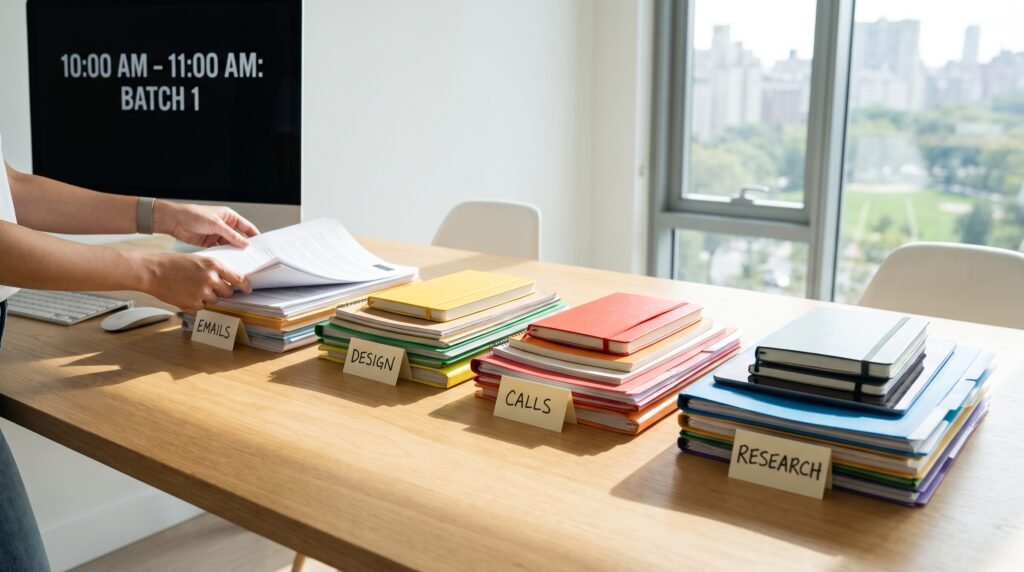
Habit 7: They Batch Similar Tasks
What it is: Grouping similar low-focus tasks together and handling them in one dedicated block instead of scattering them throughout the day.
Why it works: Every time you switch task types — from writing to emailing to a quick call and back to writing — you pay a small cognitive tax to re-orient. Do that a dozen times a day and it adds up to a significant chunk of lost focus. Batching consolidates that cost into one transition instead of many.
How to apply it today:
- Check and respond to email at two or three set times a day instead of continuously
- Batch phone calls, invoicing, or admin work into a single block, ideally during a lower-energy period
- Group similar creative tasks (e.g., all writing, or all design work) together rather than alternating
- Turn off email and messaging notifications outside your designated batching windows
Habit 8: They Use the Two-Minute Rule
What it is: If a task takes less than two minutes, it gets done immediately instead of being added to a list.
Why it works: Small tasks feel harmless individually, but they pile up into a mental backlog that quietly drains focus and creates a nagging sense of being behind. Handling them the instant they appear — rather than deferring and re-encountering them later — prevents the buildup entirely and keeps your task list reserved for things that actually deserve deliberate planning.
How to apply it today:
- Ask “will this take less than two minutes?” before adding anything to your to-do list
- If yes, do it immediately — reply to the email, file the document, make the call
- If no, schedule it properly instead of letting it float indefinitely
- Do a daily 5-minute sweep of small nagging tasks so nothing quietly accumulates
Habit 9: They Run a Weekly Review
What it is: A short, regular check-in — typically 20–30 minutes — to reflect on the past week and plan the next one.
Why it works: Daily to-do lists are reactive; a weekly review is proactive. It’s an underrated habit that most productivity advice skips over in favor of daily hacks, but it’s often what separates people who course-correct early from people who only notice they’re off track once a deadline is already blown. It also does wonders for reducing that low-grade Sunday-night anxiety that comes from feeling unprepared for the week ahead.
How to apply it today:
- Pick a consistent time each week (Friday afternoon or Sunday evening both work well)
- Review what got done, what didn’t, and why
- Identify your top 3 priorities for the coming week before it starts
- Clear out your inbox, task list, and calendar so you start the week with a clean slate
Habit 10: They Engineer Their Environment for Focus
What it is: Designing your physical and digital surroundings to make focus the path of least resistance, instead of relying on discipline to resist distraction.
Why it works: Willpower is a limited resource, so high achievers don’t waste it fighting their environment all day. If your phone is on the desk, you’ll eventually pick it up — not because you’re weak, but because that’s how attention works. Removing the temptation is far more effective than resisting it repeatedly.
How to apply it today:
- Keep your phone in a different room (or a drawer) during focus blocks
- Turn off non-essential notifications by default, not just during work
- Keep your workspace visually clear of unrelated tasks and clutter
- Use website blockers during deep work sessions if digital distraction is a recurring issue
How to Actually Build These Habits (Without Burning Out)
Reading a list of 10 habits and trying to implement all of them Monday morning is a fast track to giving up by Wednesday. Here’s how high achievers actually build habits that stick:
- Start with one, not ten. Pick the single habit that addresses your biggest current pain point — usually either the power hour, time-blocking, or the shutdown ritual — and focus only on that for two to three weeks.
- Stack it onto an existing routine. Attach the new habit to something you already do consistently (e.g., “After I pour my coffee, I write my top 3 priorities”). This is called habit stacking, and it dramatically increases follow-through.
- Track consistency, not intensity. A habit done imperfectly five days a week beats a habit done perfectly once. Use a simple checkmark system rather than aiming for flawless execution.
- Expect friction in the first two weeks. Most habits feel unnatural before they feel automatic. That discomfort is normal, not a sign you’re doing it wrong.
- Layer in the next habit only once the first feels automatic. Trying to build all 10 at once splits your willpower too thin to build any of them properly.
Final Thoughts
If there’s one thing to take away from this article, it’s that productivity habits aren’t a personality trait some people are lucky enough to have — they’re systems anyone can build, one deliberate choice at a time. High achievers don’t rely on motivation because they know it’s unreliable. Instead, they’ve built repeatable routines that protect their focus, work with their energy instead of against it, and remove the small daily frictions that quietly drain the average person’s day.
You don’t need to adopt all 10 habits at once, and you definitely don’t need to overhaul your entire life this week. Pick one — maybe it’s the power hour, maybe it’s the shutdown ritual — and give it two weeks of honest effort. That’s genuinely how every high achiever started: not with a perfect system, but with one small habit that stuck.
Which one will you try first?