You know the feeling. You sit down, grab a fresh notepad or open your favorite app, and write out everything you need to do. For a moment, it feels amazing—organized, in control, ready to conquer the day. Then five o’clock rolls around, and you’re staring at a list where two things are crossed off and eleven are not. Again.
Here’s the thing almost nobody tells you: the problem usually isn’t your discipline. It’s your list design. A poorly built to-do list sets you up to fail before you’ve even started your first task. Most of us were never taught how to actually write one—we just assumed scribbling tasks onto a page was enough.
It isn’t. And that’s actually great news, because it means finishing your list is a fixable skill, not a personality flaw.
In this guide, I’m sharing to-do list tips grounded in how your attention, motivation, and memory really work—not the recycled “just prioritize better” advice you’ve read a hundred times. By the end, you’ll know exactly how to build a list you’ll actually finish. Let’s get into it.
- Why Most To-Do Lists Fail (Before You Write a Single Task)
- Write Tasks as Actions, Not Topics
- The Rule of 3: Cap Your Daily List
- Time-Anchor Your Tasks
- Match Tasks to Your Energy, Not Just the Clock
- Make the First Task Stupidly Easy
- Separate "Today" From "Someday": The Two-List System
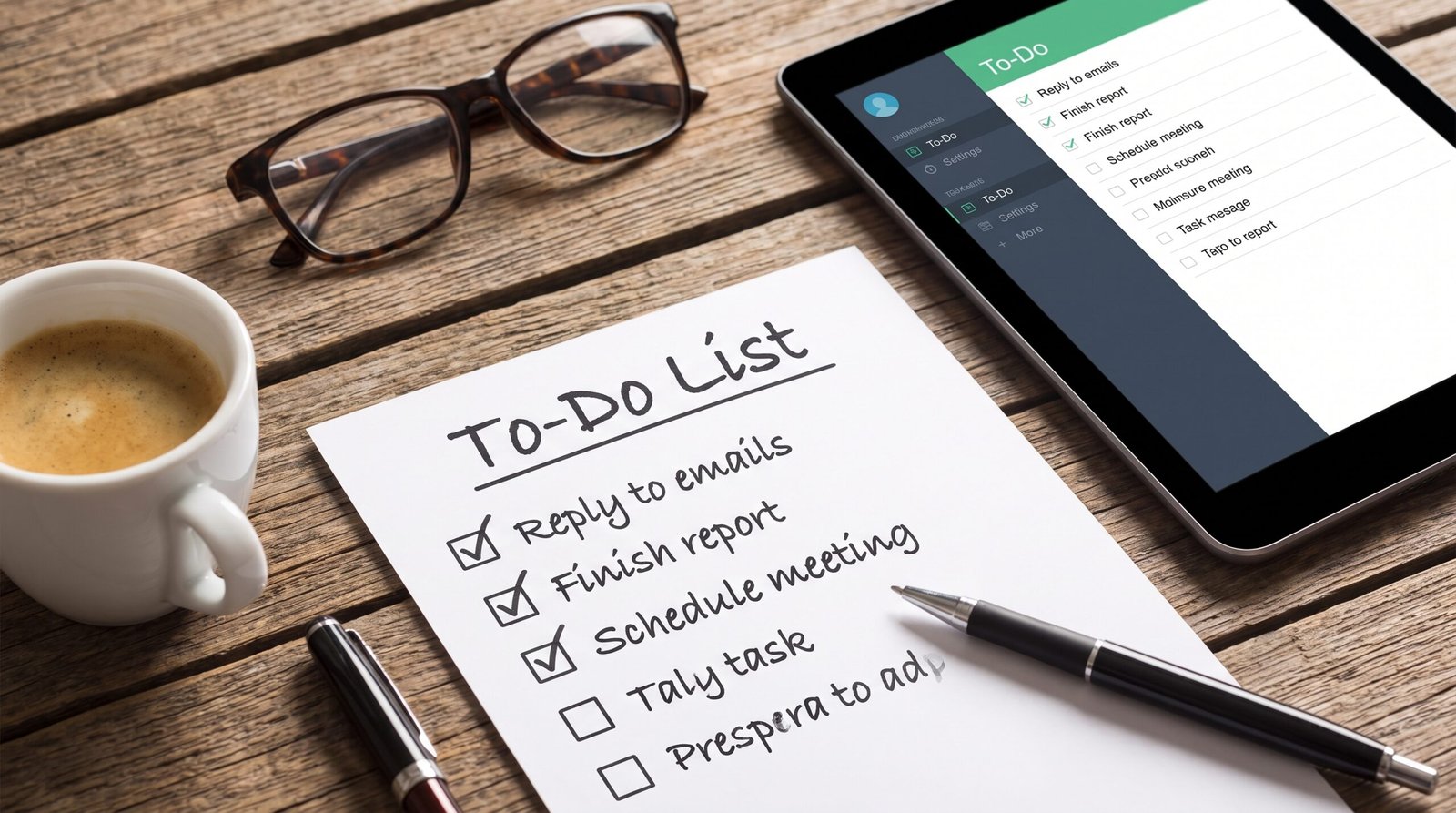
- Choose the Right Tool: Paper vs. Digital
- Review, Reflect, and Roll Over
- To-Do List Tips at a Glance
- Final Thoughts
- Frequently Asked Questions
Why Most To-Do Lists Fail (Before You Write a Single Task)
If you finish your list only about a third of the time, you’re not lazy—you’re probably writing the wrong kind of list. Before we fix anything, it helps to understand why lists collapse, because the failure almost always happens at the writing stage, not the doing stage.
Most people write a wish list, not a work list. There’s a huge difference between “grow my business” and “email three potential clients before lunch.” One is an aspiration; the other is an action. When your list is full of vague hopes, you spend your energy just trying to figure out what to actually do—and that friction is exactly where motivation goes to die.
Then there’s the planning fallacy, a well-documented quirk where we chronically underestimate how long things take. You block “write report” as a quick afternoon task, and three hours later you’re still going. Stack a few of those miscalculations together, and a list that looked reasonable at 9 a.m. becomes impossible by noon.
There’s also a sneaky psychological trap I call the fresh-list high. Making the list feels productive. You get a little hit of satisfaction from writing everything down, and your brain quietly rewards you before you’ve done a single thing. Ever noticed how you sometimes feel weirdly accomplished right after planning—and then oddly reluctant to start? That’s the trap in action.
And here’s the insight most productivity advice misses: an unfinished list isn’t neutral. Every task you didn’t cross off creates a low hum of guilt. Left unaddressed, that guilt makes you start avoiding the list entirely, which of course guarantees more unfinished tasks. It’s a doom loop, and the way out isn’t more willpower—it’s a better-designed list.
Fix the list itself, and finishing gets dramatically, almost suspiciously, easier. Here’s how.
Write Tasks as Actions, Not Topics
This is the single most overlooked to-do list tip, and it’s the one I’d tattoo on people’s hands if I could: start every item with a verb.
Look at the difference:
- “Mom’s birthday” → “Text Mom to pick a date for her birthday dinner”
- “Website” → “Rewrite the homepage headline”
- “Taxes” → “Gather last three bank statements for accountant”
The vague versions on the left aren’t tasks—they’re topics. And every time your eyes land on a topic, your brain has to stop and re-decide what the actual next step is. That tiny moment of “wait, what am I supposed to do with this?” is enough to make you skip it and move to something easier, like checking your phone.
Action-based tasks remove that friction. They tell you precisely what to do the second you read them, so there’s no re-thinking required—you just do the thing.
The trick that makes this work is asking yourself: “What’s the very next physical action?” Not the whole project, just the immediate next move. “Plan vacation” is a project. “Search flights to Lisbon for June” is a next action. Your to-do list should be full of next actions, and you’ll be amazed how much lighter it feels when it is.
The Rule of 3: Cap Your Daily List
Let’s talk about length, because this is where most people sabotage themselves. A to-do list with twenty items on it isn’t ambitious—it’s a setup for guaranteed failure. You cannot finish twenty meaningful tasks in a day, and deep down you know it, which means you start the morning already braced for disappointment.
Try this instead: Big 3 + Bonus.
Choose three tasks that genuinely must get done today. Those are your Big 3. Everything else goes on a separate “bonus” section—things you’ll do if you have time and energy, but that carry zero guilt if they slide to tomorrow.
Why three? Because a completed short list builds momentum, while an unfinished long list erodes it. When you cross off all three of your must-dos, you get to end the day feeling like you won. That feeling is fuel—it makes you want to show up and do it again tomorrow. Compare that to crossing off eight of twenty items and feeling like you fell behind, even though eight things is objectively a lot.
Here’s the reframe that makes this stick: shrinking your list isn’t lowering your standards—it’s a performance strategy. Athletes don’t train every muscle to failure every single day; they focus their effort where it counts. Your attention is a limited resource, and pointing it at three important things beats scattering it across twenty.
Time-Anchor Your Tasks
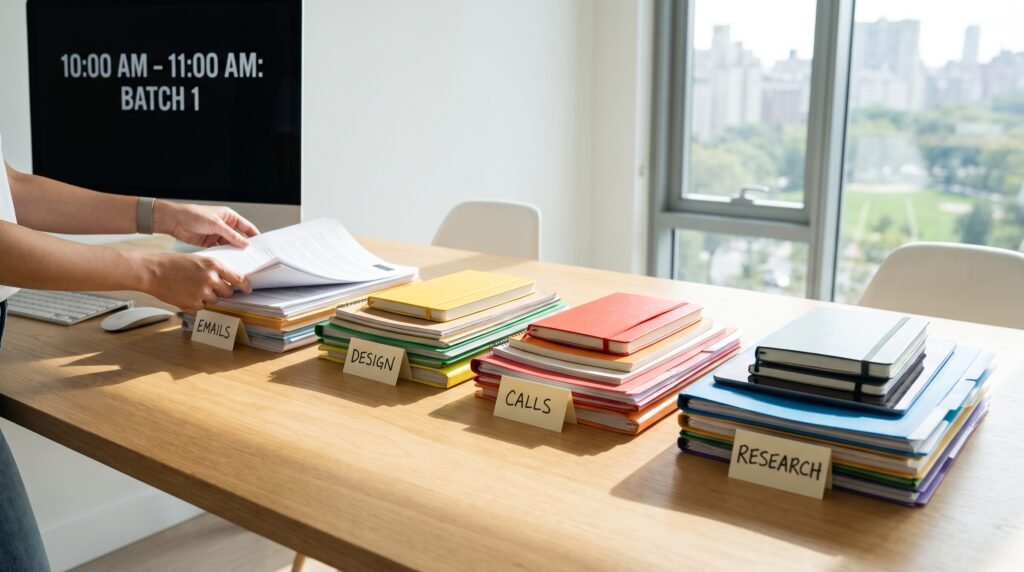
A list without time attached to it is just a wish. This is one of the biggest differences between people who finish their lists and people who don’t: the finishers don’t just list their tasks, they decide when each one happens.
There’s solid research behind this. When you pair a task with a specific “when and where”—psychologists call these implementation intentions—you’re far more likely to follow through. “I’ll respond to emails” is weak. “I’ll respond to emails at 10 a.m. at my desk” is dramatically stronger, because you’ve already made the decision, so there’s nothing left to negotiate with yourself in the moment.
You don’t need to schedule your entire day down to the minute. Even loose time-anchoring works wonders:
- Assign each of your Big 3 a rough time block (“morning,” “after lunch,” “before I log off”).
- Give each task a rough duration estimate—and then, remembering the planning fallacy from earlier, pad it by about 50%. If you think a task takes 30 minutes, block 45.
That padding isn’t pessimism; it’s realism. When your list matches the actual shape of your day, you stop overcommitting, and “finishing” suddenly becomes achievable instead of aspirational.
Match Tasks to Your Energy, Not Just the Clock
Here’s a perspective most productivity posts completely skip: managing your energy matters more than managing your time.
Think about it. You have hours in the day when your brain is sharp, focused, and ready for hard thinking—and hours when you’re running on fumes, capable of little more than deleting emails. If you schedule your most demanding, brain-heavy task for the exact moment your energy bottoms out, no amount of discipline will save you. You’ll stall, feel guilty, and probably scroll social media instead.
The fix is to map your tasks to your natural energy rhythms:
- Peak-energy hours (for many people, mid-morning) → your hardest, most important work. Deep focus, creative thinking, big decisions.
- Low-energy hours (often the mid-afternoon slump) → batch your low-stakes admin: filing, replying, scheduling, tidying.
If you’re a night owl whose brain doesn’t switch on until 11 a.m., don’t fight it—stop scheduling your most important task for 8 a.m. and wondering why you keep failing. An energy-aware to-do list works with your biology instead of against it.
This one shift explains why so many carefully planned lists fall apart: it wasn’t the plan that was broken, it was the timing. Put the right task in the right energy window, and it practically does itself.
Make the First Task Stupidly Easy
The hardest part of any task is starting. That initial resistance—the “activation energy” you have to overcome to get going—is what kills more to-do lists than anything else. Once you’re moving, momentum takes over. The trick is engineering that first push so it’s almost impossible to resist.
So make your first task of the day stupidly, embarrassingly easy. Something that takes two minutes or less. “Open the document and write one sentence.” “Reply to that one quick text.” “Fill in the subject line of the email.”
Two things happen when you do this. First, you break the seal — the psychological barrier between “not working” and “working” disappears. Second, you get an early win, and wins are motivating. One tiny crossed-off item makes you want to cross off another, and another, and suddenly you’re deep into the hard stuff you were dreading an hour ago.
I’ll say it plainly: deliberately put an easy anchor task at the top of your list. It’s not cheating. It’s using how your brain works to your advantage.
Separate “Today” From “Someday”: The Two-List System
One of the fastest ways to overwhelm yourself is keeping every single thing you might ever need to do on one giant master list. Staring at fifty tasks is paralyzing, and it makes choosing what to actually work on today feel like an impossible decision.
The solution is to run two lists.
- The Brain Dump. This is your capture list—the place where everything lives. Every idea, errand, project, and half-formed “I should probably…” goes here so it’s out of your head and safely stored. The point of this list isn’t to do it all; it’s to make sure nothing gets forgotten.
- The Today List. Each day, you pull only a few tasks from the Brain Dump onto your Today list—your Big 3, essentially. This is the clean, short, doable list you actually work from.
The magic is in a quick weekly review where you look over your Brain Dump, cross out things that no longer matter, and decide what deserves to move onto your daily lists in the coming week. This keeps your day-to-day list refreshingly clean without the anxiety of losing track of that brilliant idea you had in the shower.
Your daily list stays focused. Your big-picture list stays complete. Nothing falls through the cracks, and nothing overwhelms you. Best of both worlds.
Choose the Right Tool: Paper vs. Digital
People love to argue about this one, so let me give you the honest, non-dogmatic answer: the best to-do list tool is the one you’ll actually open. That’s it. That’s the whole rule.
That said, each format has real strengths:
Paper is tactile and satisfying. There’s a genuine, well-documented little reward in physically crossing something off. It’s also distraction-free—a notebook can’t ping you with a notification or tempt you to “quickly check” something. Many people focus better with pen and paper, full stop.
Digital wins on reminders, search, syncing across devices, and handling recurring tasks. If you need something to nudge you at 3 p.m. whether you remember or not, an app is your friend. It’s also easier to reshuffle and carry hundreds of tasks without the mess.
Plenty of people run a hybrid: a digital master list for capture and reminders, plus a handwritten daily list for focus. That combination is honestly hard to beat.
One warning, though. Watch out for productivity-app hopping—endlessly trying new tools, tweaking settings, and reorganizing your system. It feels productive, but it’s usually just procrastination wearing a very convincing disguise. Pick a tool that’s good enough, and then get to work. The tool was never the thing standing between you and a finished list.
Review, Reflect, and Roll Over
This is the step almost everyone skips, and it’s the one that quietly turns an ordinary to-do list into a system that gets better over time.
At the end of your day, take five minutes to review. Look at what got done, what didn’t, and—this is the important part—why. Did that task not happen because you ran out of time? Because your energy was in the wrong place? Because it was actually a vague topic and not a real next action? Each unfinished task is a clue about how to build a better list tomorrow.
The key here is to do this without self-blame. The review isn’t a courtroom; it’s a debrief. “I didn’t finish the report” isn’t a moral failing—it’s data. Maybe it needed to be broken into smaller steps. Maybe you scheduled it for your low-energy hour. Adjust, and move on.
Then roll over what still matters to tomorrow’s list, and let go of what doesn’t. Some tasks reveal, through repeated postponement, that you don’t actually need to do them at all—and crossing those off by deleting them is just as valid as finishing them.
Do this consistently, and your to-do list stops being a static wish list and becomes a feedback loop—one that teaches you more about how you work every single day.
To-Do List Tips at a Glance
Short on time? Here’s the whole playbook in one scannable place:
- Write actions, not topics. Start every task with a verb and define the next physical step.
- Cap your list at three must-dos. Use “Big 3 + Bonus” to build momentum instead of guilt.
- Time-anchor each task. Attach a “when and where,” and pad your time estimates by 50%.
- Match tasks to your energy. Hard work in your peak hours, admin in your slumps.
- Make the first task tiny. A two-minute starter beats activation energy and creates momentum.
- Run two lists. A complete “Brain Dump” for capture, a short “Today” list for doing.
- Pick one tool and commit. The best tool is the one you’ll open—stop app-hopping.
- Review daily, without blame. Ask why tasks didn’t get done, then roll over what matters.
Keep this list somewhere handy. Even adopting two or three of these habits will transform how many of your tasks actually get finished.
Final Thoughts
If there’s one idea I hope sticks with you, it’s this: finishing your to-do list is a design problem, not a character flaw. All those abandoned lists weren’t proof that you lack discipline. They were just poorly built—full of vague topics, impossible lengths, and tasks scheduled for the wrong moments. Now you know how to build them better.
So don’t try to overhaul everything at once. Grabbing all nine tips and attempting them tomorrow is its own kind of overwhelm. Instead, pick one—maybe writing your tasks as actions, or capping your list at three—and try it for a week. Once it feels natural, add another.
Small, deliberate changes to how you write your list will do more for your productivity than any burst of willpower ever could. You’ve got this—now go make a list you’ll actually finish.