Let’s be honest: almost everyone has stood in front of a mirror in January and thought, “This is the year I finally get fit.” And by February? The gym bag is collecting dust in the closet, and “get healthier” has quietly slipped down the priority list.
Here’s the thing—it’s usually not a motivation problem. It’s a goal problem. When you set a fuzzy target like “lose weight” or “be more active,” your brain has nothing concrete to grab onto. There’s no clear first step, no way to measure progress, and no obvious moment where you get to feel like you’re winning.
That’s exactly what we’re fixing today. Below you’ll find 20 real-world fitness goals examples you can copy, tweak, and make your own—organized by category so you can jump straight to what fits your life right now. But more importantly, these aren’t just goals. They’re built around the one ingredient that actually gets people fit and keeps them there: consistency.
Let’s dig in.
- Why Most Fitness Goals Fail (And How to Fix It)
- How to Use These Fitness Goals Examples
- Beginner-Friendly Fitness Goals Examples
- Strength & Muscle-Building Fitness Goals Examples
- Cardio & Endurance Fitness Goals Examples
- Weight & Body Composition Fitness Goals Examples
- Flexibility, Mobility & Recovery Fitness Goals Examples
- Consistency & Habit-Based Fitness Goals Examples
- How to Set Fitness Goals That Actually Stick
- Common Mistakes to Avoid When Setting Fitness Goals
- Final Thoughts
- Frequently Asked Questions
Why Most Fitness Goals Fail (And How to Fix It)
Before we get to the examples, it’s worth understanding why so many well-intentioned goals fall apart—because once you see the pattern, you’ll never set a goal the same way again.
The number one culprit is vagueness. “I want to be healthier” sounds nice, but it gives your brain zero instructions. Healthier how? By when? Doing what, exactly? Without answers, there’s nothing to act on, so nothing happens.
You’ve probably heard of the SMART framework—goals that are Specific, Measurable, Achievable, Relevant, and Time-bound. It’s genuinely useful, and every good goal on this list follows it. But I want to add a twist that most fitness advice skips over.
The real secret is pairing two types of goals together:
- Outcome goals tell you where you’re going—like “lose 10 pounds” or “run a 5K.” They’re motivating and give you direction.
- Process goals tell you what to do daily—like “walk 8,000 steps” or “strength train three times a week.” They’re what actually build the habit.
Here’s why this matters: you can’t directly control an outcome. You can’t make the scale drop on a given Tuesday. But you can control whether you laced up your shoes and went for that walk. Process goals put your focus on the actions you can repeat, and repeated actions are what get you fit.
And that leads to the biggest mindset shift of all: consistency beats intensity every single time. A moderate workout you do four times a week for a year will transform your body far more than a brutal bootcamp you quit after two weeks. Keep that in your back pocket as you read on.
How to Use These Fitness Goals Examples
Quick game plan before you dive in, because this part trips people up.
Don’t try to do all 20. Seriously. Pick just one or two goals that genuinely excite you right now. Chasing everything at once is the fastest way to burn out and quit.
Match the goal to your reality. Choose based on your current fitness level, your schedule, and what you actually enjoy. A goal you dread is a goal you’ll abandon.
The examples below are grouped into six categories—beginner, strength, cardio, weight and body composition, flexibility and recovery, and consistency. Feel free to skip straight to the section that speaks to you.
Beginner-Friendly Fitness Goals Examples
If you’re just starting out (or restarting after a long break), these are your bread and butter. They’re approachable, hard to fail, and they build the momentum everything else depends on.
1. Walk 8,000 Steps a Day
Walking is criminally underrated. It’s free, low-impact, and easy to slot into your day. Aiming for 8,000 steps gives you a clear, trackable target that most phones and watches count automatically. Start where you are—if you’re at 3,000, aim for 5,000 first, then build up.
2. Complete Three 20-Minute Workouts Per Week
Notice the goal is three sessions, not “work out more.” Twenty minutes is short enough to feel doable on a busy day, and three times a week is enough to build a real habit without overwhelming your schedule. Put the sessions in your calendar like any other appointment.
3. Drink Half Your Body Weight in Ounces of Water Daily
Hydration affects energy, recovery, and even hunger signals. A simple rule of thumb: take your body weight in pounds, halve it, and drink that many ounces of water. Fill a marked bottle each morning so you can see your progress at a glance.
4. Do a Full Push-Up (Progress From Knee Push-Ups)
This is a fantastic beginner strength goal because progress is so visible. Start with wall or knee push-ups, then work toward your first full-body rep. Measurable, motivating, and it builds real upper-body strength along the way.
5. Stretch for 10 Minutes Every Morning
Ten minutes of gentle stretching kickstarts your day, improves mobility, and creates a tiny fitness ritual that anchors the rest of your habits. Pair it with something you already do—like right after brushing your teeth—so it sticks.
Strength & Muscle-Building Fitness Goals Examples
Ready to build some muscle? These goals give you concrete strength targets to chase, and hitting them feels genuinely awesome.
6. Deadlift Your Body Weight
Lifting your own body weight off the floor is a classic strength milestone. It’s specific, measurable, and it builds full-body power. Work with a trainer or follow a structured program to nail your form first—this one rewards patience.
7. Add 5 lbs to a Key Lift Every Two Weeks (Progressive Overload)
This is the engine behind all strength gains: progressive overload, which just means gradually asking your muscles to do a little more over time. Pick one core lift and aim to add small amounts of weight consistently. It’s slow, steady, and shockingly effective.
8. Do 10 Consecutive Pull-Ups
Pull-ups are tough, which is exactly why hitting 10 in a row feels like such a victory. Use resistance bands or assisted machines to start, then chip away at your number. Perfect for anyone who loves a clear, hard-to-fake benchmark.
9. Hold a 2-Minute Plank
A strong core supports every other movement you make. Time yourself, note your baseline, and add a few seconds each week until you reach the two-minute mark. Simple to test, and no equipment required.
Cardio & Endurance Fitness Goals Examples
Want a stronger heart and lungs? These endurance goals are measurable, satisfying, and great for tracking real-world progress.
10. Run a 5K Without Stopping
The 5K (3.1 miles) is the perfect first running goal. A beginner program like Couch to 5K breaks it into manageable steps, and finishing your first continuous 5K is a milestone you’ll never forget.
11. Cycle 50 Miles in a Month
If running isn’t your thing, cycling is a joint-friendly alternative. Setting a monthly mileage target lets you break it into small rides throughout the week and watch the total climb. Great for building endurance without the pounding.
12. Lower Your Resting Heart Rate by 5 BPM
Here’s a goal most people never think of, and it’s a brilliant one. Your resting heart rate is a real indicator of cardiovascular fitness — and as you get fitter, it drops. Track it each morning with a wearable and watch the number fall over the weeks.
13. Climb 20 Flights of Stairs Without Getting Winded
A wonderfully practical goal that shows up in everyday life. Stair climbing torches calories and builds leg strength and lung capacity. Start with a few flights and add more as your breathing gets easier.
Weight & Body Composition Fitness Goals Examples
Weight-related goals are some of the most common—but the smartest versions focus on how your body composition changes, not just the number on the scale.
14. Lose 1% Body Fat Per Month
Instead of chasing scale weight (which bounces around for all sorts of reasons), target body fat percentage. Losing around 1% per month is realistic and sustainable, and it reflects genuine change in your body rather than water fluctuations.
15. Fit Into a Specific Pair of Jeans
This is my favorite kind of goal: a non-scale victory. Pick a pair of jeans you’d love to wear comfortably again, and use them as your progress tracker. No math, no scale anxiety—just a clear, motivating, real-world checkpoint.
16. Gain 5 lbs of Lean Muscle in 12 Weeks
Not everyone wants to lose weight—some folks want to build. Gaining lean muscle takes consistent strength training and enough protein, and a 12-week window gives you a realistic runway to see meaningful results.
Flexibility, Mobility & Recovery Fitness Goals Examples
Fitness isn’t only about pushing hard—it’s also about moving well and recovering properly. These often-ignored goals keep you injury-free and feeling great.
17. Touch Your Toes
If reaching your toes feels impossible right now, that’s exactly why it’s a great goal. Improved flexibility eases back tension and improves your range of motion. A few minutes of daily stretching will get you there faster than you’d expect.
18. Attend Two Yoga or Mobility Sessions Weekly
Yoga and mobility work improve flexibility, balance, and mental calm all at once. Committing to two sessions a week makes it a routine rather than an afterthought—and your joints will thank you.
19. Get 7–8 Hours of Sleep for Better Recovery
Yes, sleep is a fitness goal. Your muscles repair and grow while you rest, and poor sleep sabotages energy, willpower, and results. Aiming for a consistent 7–8 hours might be the highest-leverage “workout” on this entire list.
Consistency & Habit-Based Fitness Goals Examples
This is where the magic really happens. If you take away one idea from this whole article, let it be this next goal.
20. Never Miss Twice: Work Out at Least Every Other Day for 30 Days
Here’s the “never miss twice” rule, and it’s a game-changer. Life happens—you’ll skip a workout now and then, and that’s completely fine. The rule is simple: you’re allowed to miss once, but never twice in a row.
Missing one day is a blip. Missing two starts a slide, and three becomes a new (bad) habit. By committing to never skipping two sessions back-to-back for 30 days, you build the identity of someone who keeps showing up—which matters more than any single workout ever could. Consistency isn’t about being perfect. It’s about being reliable.
How to Set Fitness Goals That Actually Stick
Picking a goal is the easy part. Making it last is where most people struggle. Here’s how to stack the odds in your favor.
Start smaller than you think you need to. The most common mistake is going too big, too fast. Attach your new goal to something you already do—stretch right after your morning coffee, or do squats while the kettle boils. This is called habit stacking, and it works because it borrows momentum from a routine that’s already automatic.
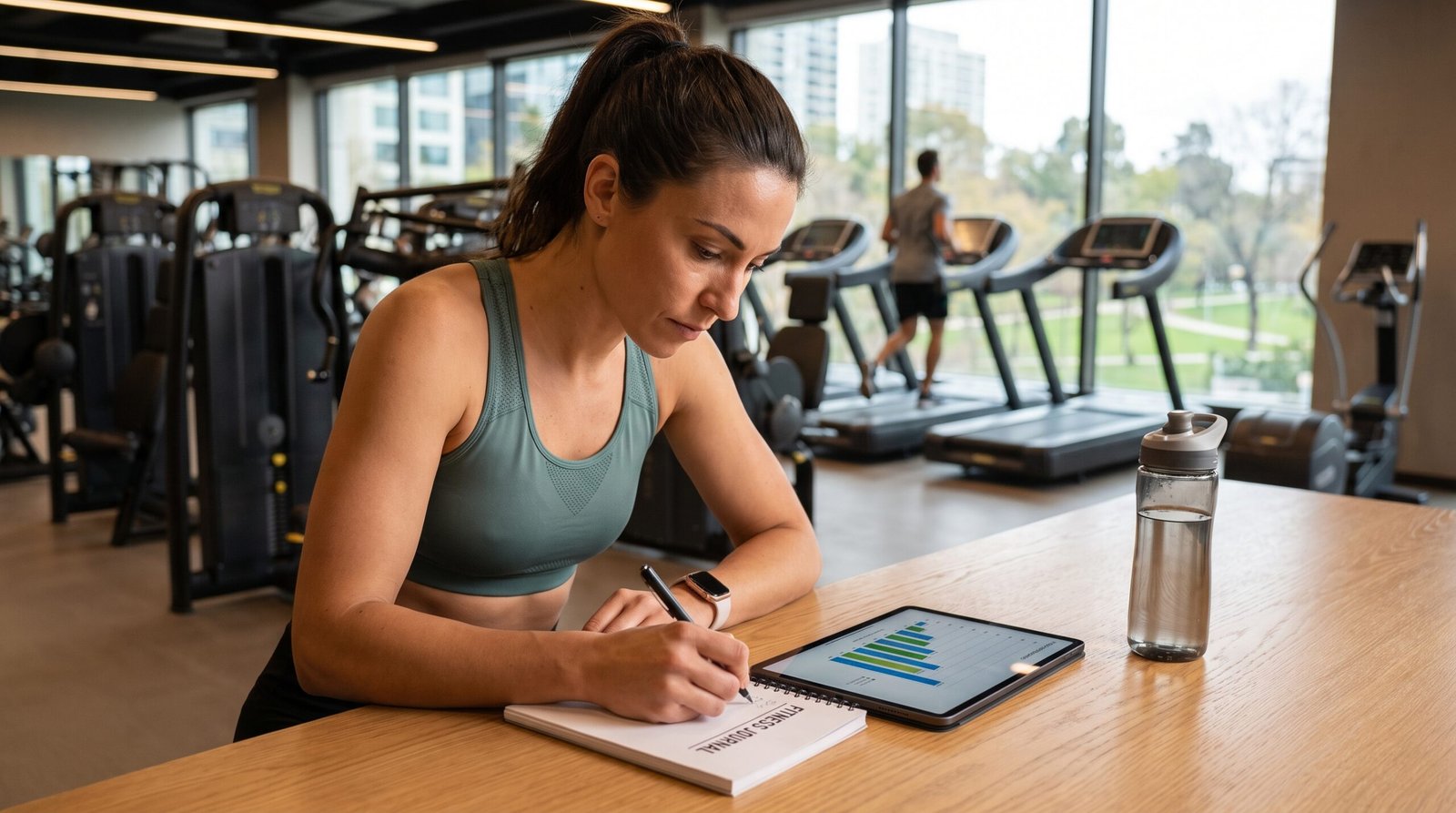
Track everything. Use an app, a journal, or a simple calendar where you mark an X on every day you show up. Watching a streak grow becomes weirdly motivating—you won’t want to break the chain.
Build in accountability. Tell a friend, recruit a workout buddy, join a community, or hire a coach. When someone else knows your goal, you’re far more likely to follow through.
Celebrate the small wins. Don’t wait until you hit the big finish line to feel proud. Every walk, every rep, every session is a win worth acknowledging. And reassess your goals every four to six weeks—adjust them up or down based on how things are actually going.
Finally, here’s a pro tip that quietly separates the people who stay consistent from the people who don’t: create a minimum viable workout. This is a scaled-down version of your goal for your worst, lowest-energy days—think one set of push-ups, or a five-minute walk. On days when doing the full session feels impossible, you do the tiny version instead. Why? Because the goal isn’t just fitness; it’s never breaking the streak. Showing up small still counts as showing up.
Common Mistakes to Avoid When Setting Fitness Goals
Even great goals can get derailed by a few predictable traps. Watch out for these:
- Setting too many goals at once. Spreading your energy across five goals usually means making progress on none. Focus beats ambition here.
- Copying someone else’s goals. What works for a fitness influencer with three free hours a day may not fit your life. Choose goals that match your schedule and preferences.
- Ignoring the daily process. If you only track outcomes and never define the daily actions, you’ll feel stuck whenever the scale doesn’t move. Anchor yourself to process goals you control.
- No timeline or measurement. “Get stronger someday” isn’t a goal—it’s a wish. Give every goal a number and a deadline.
- All-or-nothing thinking. One missed workout or one off-plan meal doesn’t undo your progress. The people who succeed are the ones who shrug off slip-ups and get right back to it.
Final Thoughts
Here’s the big idea to carry with you: the best fitness goal isn’t the most ambitious one—it’s the one you’ll actually repeat. Fancy plans mean nothing if you can’t sustain them, while simple, consistent actions compound into results that genuinely change your life.
So don’t overthink this. Scroll back up, pick just one or two of these fitness goals examples that made you think “I could actually do that,” and start this week. Not Monday, not next month—this week.
Remember, you don’t have to be perfect. You just have to keep showing up, again and again, especially on the days you don’t feel like it. That’s the whole secret. Small actions beat perfect plans every time.
Now go choose your goal—and maybe bookmark this list so you can come back and pick your next one when you’re ready. Which one are you starting with?