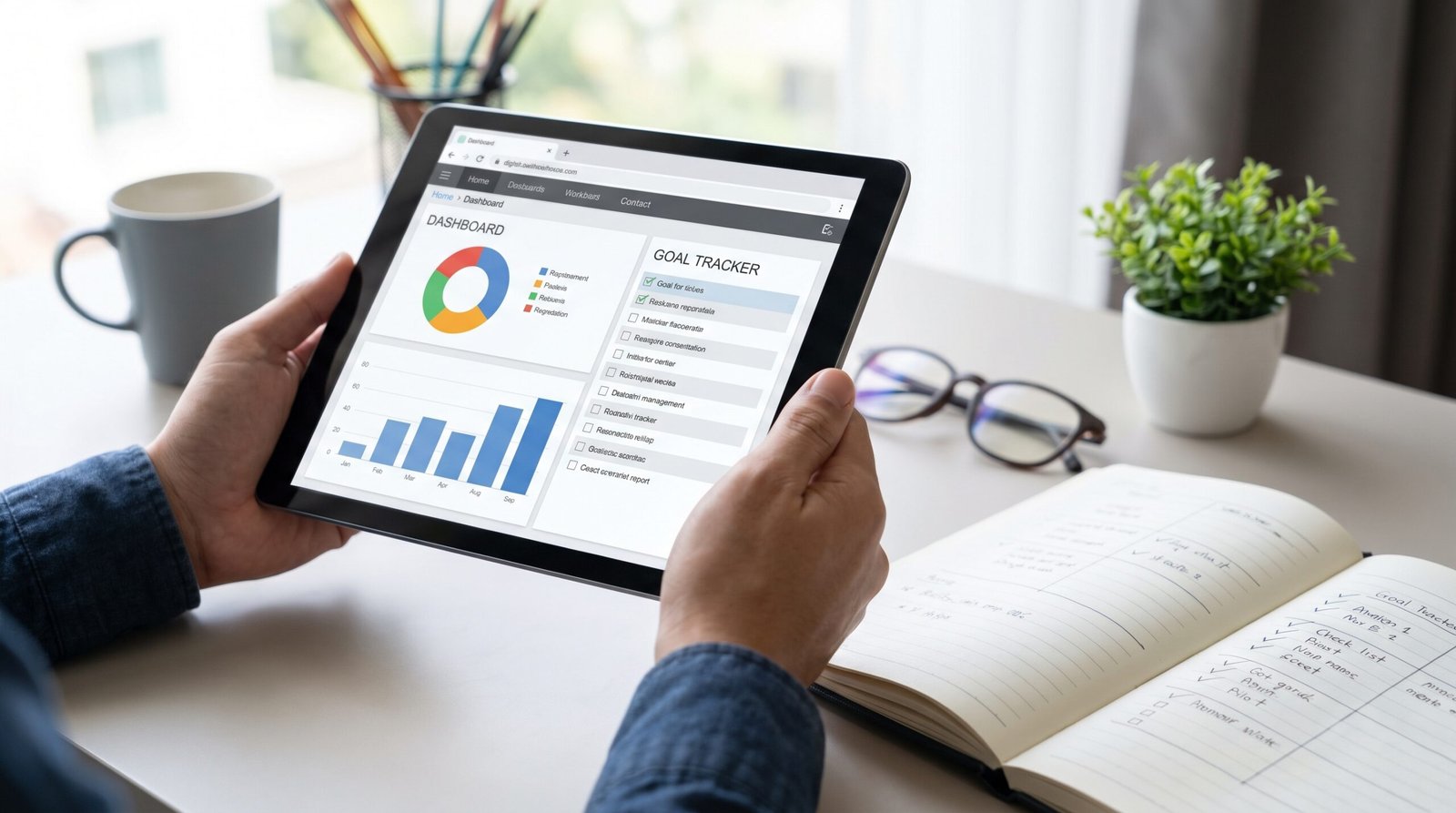
Every January, millions of people set goals with real conviction. By March, most of those goals have quietly disappeared — not because the goals were bad, and not because the people were lazy, but because nobody was keeping score.
Here’s the thing most productivity advice gets wrong: if you keep setting goals and losing steam, you probably don’t have a motivation problem. You have a tracking problem. Motivation is what gets you started, but a good tracking system is what keeps you going long after the initial excitement wears off.
Learning how to track goals consistently is the difference between goals that fade and goals that finish. And the good news? It’s a skill, not a personality trait. You don’t need more willpower — you need a system that makes progress visible and follow-through automatic.
In this guide, you’ll get 8 practical goal-tracking methods, ranging from a simple paper journal to app-based dashboards, plus a straightforward way to pick the right one for how your brain actually works. The short version: track goals by choosing one visible system, reviewing it on a fixed schedule, and pairing it with an accountability trigger. Let’s get into the details.
Why Tracking Your Goals Actually Matters
Tracking works because of a simple psychological truth: we improve what we watch. When you measure something regularly, you create a feedback loop, and feedback loops are what actually drive behavior change. This is sometimes called the “measurement effect” — the mere act of monitoring a behavior nudges you toward improving it, often before you’ve even made a conscious plan to do so.
Beyond the psychology, tracking your goals delivers three very concrete benefits.
First, it surfaces problems early. When you’re checking in regularly, you notice a stalled goal in week two instead of month three — while there’s still plenty of time to course-correct. Second, it compounds small wins into momentum. Seeing a string of completed days or a climbing number is quietly addictive in the best way, and that visible progress becomes its own fuel. Third, it converts abstract goals into daily decisions. “Get healthier” is a wish; “did I hit my step count today?” is a decision you can actually make.
But here’s a counterintuitive insight most articles won’t tell you: over-tracking can backfire. If your system is so detailed that maintaining it feels like a second job, you’ll abandon it — and a system you’ve abandoned tracks nothing. The best goal-tracking system isn’t the most sophisticated one. It’s the one you’ll actually keep using six weeks from now.
What Makes a Goal-Tracking System Stick?
Throughout this guide, I’ll keep coming back to three criteria that separate systems that last from systems that get abandoned by February:
- It’s visible. If you can’t see it without digging, you’ll forget it. Out of sight really is out of mind.
- It’s low-friction. The easier it is to update, the more likely you are to update it. Every extra step is a reason to quit.
- It has a built-in review rhythm. A tracker you never look back on is just data collection. The review is where the magic actually happens.
Keep these three in mind as we go — they’re the lens for evaluating every method below.
How to Track Your Goals: 8 Methods That Keep You Accountable
There’s no single “correct” way to track goals — only the way that fits your goal type, your lifestyle, and your personality. Below are eight proven methods. For each one, you’ll get what it is, who it’s best for, how to set it up, and one insider tip most people miss.
1. The Classic Goal Journal (Analog Tracking)
Sometimes the oldest method is still the best one. A goal journal is simply a dedicated notebook where you write down your goals and check in on them regularly, by hand.
Best for: People who think better on paper and want to slow down enough to actually reflect. Writing by hand forces a kind of deliberate processing that typing on a screen doesn’t.
How to set it up:
- Dedicate one page per goal so each has room to breathe.
- Add a weekly check-in prompt at the top of each page — something like “What moved this forward this week?”
- Keep a running “wins” column to capture progress you’d otherwise forget.
Insider tip: Date every single entry. When you flip back through months of dated notes, you get an undeniable visual record of how far you’ve come — which is exactly the momentum-builder that keeps you going on low-motivation days.
2. Habit Trackers and Streak Systems
For goals that depend on repetition, a habit tracker is hard to beat. You mark off each day you complete the behavior, building a chain you don’t want to break.
Best for: Goals built on daily or weekly consistency — exercising, writing, reading, practicing a language, drinking enough water.
The core principle here is famously called “don’t break the chain.” Once you’ve got a streak going, the growing chain of completed days creates its own pressure to keep it alive. You’re no longer motivated by the far-off goal; you’re motivated by not wanting to break a run of 14 straight days.
Insider tip: For habit-based goals, track the behavior, not the outcome. You control whether you show up to the gym; you don’t fully control what the scale says on any given morning. Tracking the action keeps you focused on what’s actually in your hands.
3. Digital Goal-Tracking Apps
If you basically live on your phone, meet yourself where you are. Goal-tracking apps put your progress, reminders, and data right in your pocket.
Best for: People who want automatic reminders, easy data entry, and progress they can check anywhere.
Rather than fixating on specific products (which come and go), think in categories: habit-tracking apps for daily behaviors, project-management apps for multi-step goals, and OKR-style apps for outcome-based targets with measurable key results. Pick the category that matches your goal, then choose whatever well-reviewed app in that category feels intuitive to you.
Insider tip: Choose an app that offers a home-screen widget or push notifications. Remember criterion number one — visibility. An app buried in a folder on page four of your phone might as well not exist. The best app is the one that puts your goal in front of your eyes without you having to go looking.
4. The Spreadsheet Dashboard
For the data-lovers, nothing beats the control and flexibility of a spreadsheet. You build exactly the view you want and watch the numbers tell your story.
Best for: Measurable, numeric goals — revenue targets, weight, word counts, savings, miles run.
How to set it up:
- Create columns for your target, your actual result, and the variance between them.
- Add a simple progress-bar formula so you get a visual fill as you close the gap.
- Log entries on a consistent schedule so the data stays meaningful.
Authority tip: Build a trend view, not just a today view. A single day’s number tells you almost nothing; a line showing the last eight weeks tells you whether you’re winning. Add a simple chart and glance at the slope — direction matters more than any single data point.
5. SMART Goals + Milestone Mapping
Big goals are exciting, but they’re also where people freeze. Milestone mapping breaks an intimidating goal into pieces small enough to actually start on.
Best for: Large, long-horizon goals that feel overwhelming — writing a book, launching a business, running a marathon.
Start by making your goal SMART (Specific, Measurable, Achievable, Relevant, Time-bound), then break it down: a big annual goal becomes four quarterly milestones, and each milestone becomes a handful of weekly actions. Suddenly “write a book” turns into “draft 1,000 words this week,” which is something you can actually do on a Tuesday.
Unique insight: Track your leading indicators, not just your lagging indicators. A lagging indicator is the result — the finished manuscript, the revenue total — and you don’t fully control it. A leading indicator is the action that produces the result — the words written, the calls made — and you control it completely. Track what you can influence, and the results tend to follow.
6. Accountability Partners and Check-In Groups
Some of us will happily let ourselves down but would never dream of letting someone else down. If that’s you, build another person into your system.
Best for: People who follow through far more reliably for others than for themselves.
How to set it up:
- Choose a partner or small group who shares a similar drive.
- Set a fixed check-in cadence — a Sunday-evening text, a Friday call, whatever you’ll keep.
- Agree in advance on what “reporting in” actually looks like so the check-in has substance.
Insider tip: Make your commitment specific and time-bound. Vague “how’s it going?” chats quietly dissolve into small talk. “I’ll send you my three completed tasks every Friday by 5 p.m.” creates real accountability, because there’s a clear thing to report and a clear moment to report it.
7. Visual Progress Boards (Vision Board Meets Kanban)
If you’re a visual thinker, a progress board turns your goals into something you can literally see moving forward.
Best for: Visual thinkers and anyone juggling multiple goals or projects at once.
The concept borrows from kanban boards: you set up stages — typically Not Started, In Progress, and Done — and move each goal or task through them as it advances. Watching a card slide into the “Done” column delivers a small, satisfying hit of progress that keeps you engaged.
There’s an emotional layer here too. A physical board on your wall (or a digital one you open daily) keeps your goals constantly top-of-mind, blending the motivational pull of a vision board with the practical structure of a task system.
8. The Weekly Review Ritual
This last one isn’t really a standalone tracker — it’s the method that makes every other method on this list actually work.
Best for: Everyone. Think of it as the glue that holds your chosen system together.
Set aside 15 minutes once a week and walk through three questions: What worked this week? What stalled? What’s my focus for next week? That’s it. This short ritual is where you catch stalled goals, celebrate wins, and reset your priorities before they drift.
Here’s why it’s non-negotiable: a tracker without a review is just a scoreboard that nobody reads. You can log data all week long, but if you never step back to interpret it and adjust, you’re collecting numbers without learning anything from them. The weekly review is where tracking turns into actual progress.
How to Choose the Right Goal-Tracking Method for You
With eight options on the table, the natural question is: which one should you use? The answer comes down to matching the method to two things — your goal type and your personality.
Here’s a quick reference to point you in the right direction:
| If your goal is… | Best-fit method | Effort level |
| A daily habit (exercise, reading) | Habit tracker / streak system | Low |
| A big, long-term project | SMART goals + milestone mapping | Medium |
| A specific number (savings, weight) | Spreadsheet dashboard | Medium |
| Something you follow through on for others | Accountability partner | Low |
| Visual and multi-project | Progress board | Medium |
| Reflective and personal | Goal journal | Low |
| Anything, on the go | Digital app | Low |
Then layer in personality. Are you analog or digital by nature? Do you follow through better solo or with social pressure? Do you love data or find it draining? Be honest about who you actually are, not who you think you should be.
And the single most important rule: start with one method, not five. It’s tempting to build an elaborate system combining a journal, three apps, and a spreadsheet — but that’s a recipe for burnout. Pick one, run it for a few weeks, and add the weekly review on top. That’s a complete system, and it’s one you’ll actually keep.
Common Goal-Tracking Mistakes to Avoid
Even with a great method, a few common traps can quietly derail your progress. Here’s what to watch for — and how to fix each one.
Mistake 1: Tracking too many goals at once. When everything is a priority, nothing is. Spreading your attention across ten goals guarantees you’ll make real progress on none. The fix: Limit yourself to two or three active goals at a time and give them your full focus.
Mistake 2: Focusing only on outcomes. Obsessing over the result — the final number, the finished product — can leave you feeling like a failure on every day you haven’t crossed the finish line yet. The fix: Track the daily actions within your control, and let the outcomes take care of themselves.
Mistake 3: No fixed review time. Without a scheduled check-in, “I’ll review my goals later” becomes “never.” The fix: Block a recurring 15-minute slot on your calendar for your weekly review and treat it as a real appointment.
Mistake 4: Quitting after one missed day. People often abandon a whole system the moment they break a streak, as if one slip erases all progress. The fix: Adopt a “never miss twice” rule. Missing once is human; missing twice is the start of a new (bad) pattern. Just get back on track the very next day.
Final Thoughts
If you take just one idea away from this guide, make it this: the best way to track goals is the system you’ll actually return to every single week. Sophistication doesn’t matter. Consistency does. A humble paper journal you open every Sunday will beat the most powerful app you check twice and forget.
So don’t try to build the perfect system today. Just pick one method that resonated with you, set it up in the next ten minutes, and commit to a single 15-minute review seven days from now. That’s genuinely all it takes to get started.
Learning how to track goals is what transforms your ambitions from a hopeful list in January into real, visible results by December. Start small, stay consistent, and let your progress speak for itself.