Picture your last “productive” morning. Seventeen browser tabs glowing at you. Three chat windows pinging. A half-written email sitting in one corner while a spreadsheet blinks in another. You were busy—no question. But by lunchtime, how much did you actually finish?
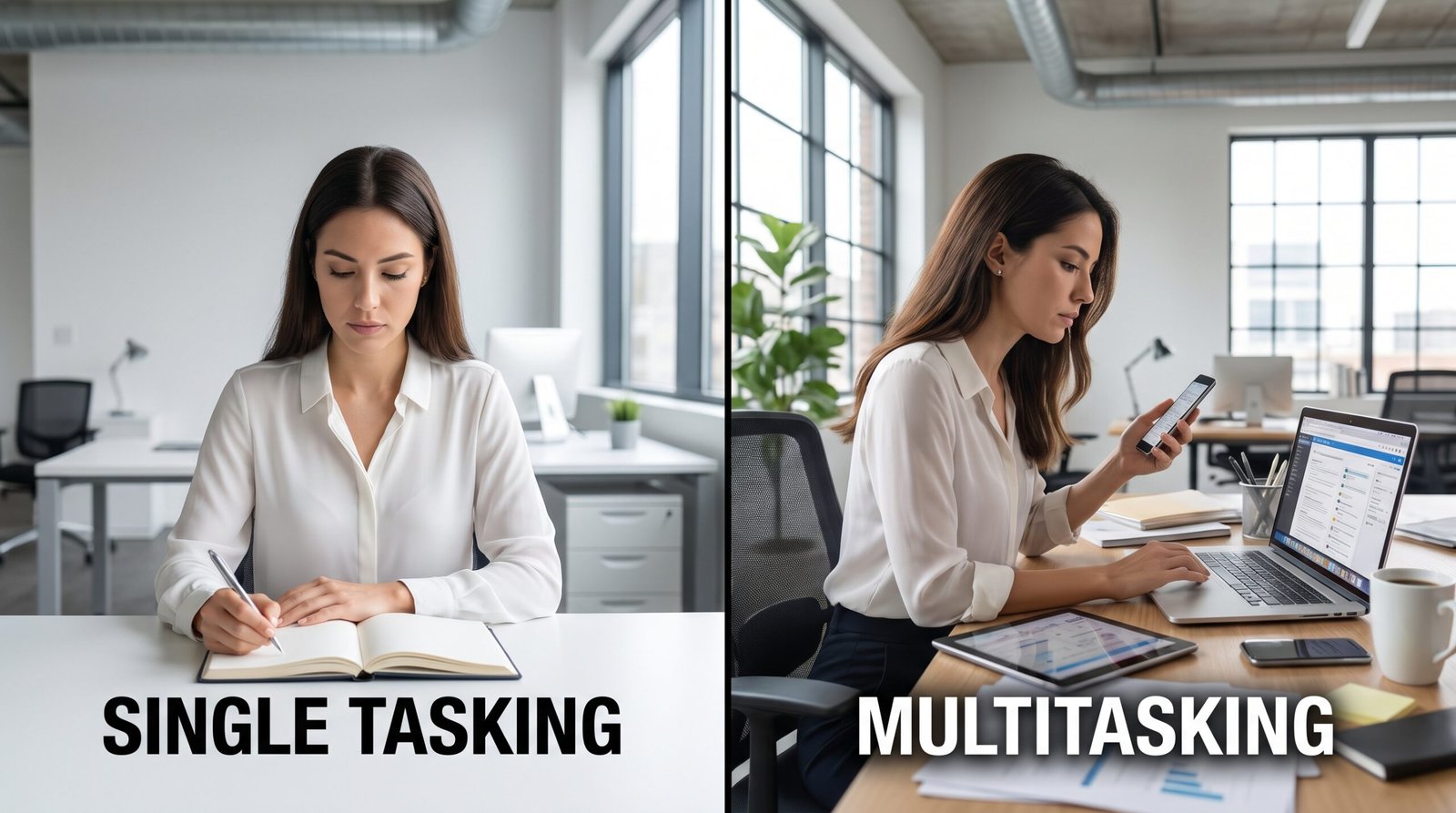
If the honest answer is “not much,” you’re not lazy and you’re not broken. You’ve just been sold a myth. We’ve been told for years that multitasking is a superpower, the mark of someone who can handle it all. But when you line up single tasking vs multitasking and look at what the research actually says, the verdict is surprisingly lopsided: doing one thing at a time wins.
Here’s the short version, in case you only read this sentence: single-tasking beats multitasking on speed, accuracy, memory, and stress—because the human brain was never built to do two demanding things at once. In this article, we’ll unpack why that’s true, where multitasking quietly costs you, the rare moments it’s actually fine, and exactly how to rebuild your focus starting tomorrow.
Let’s close some tabs.
- What Is Single-Tasking vs Multitasking?
- The Science: What Happens in Your Brain When You Multitask
- The Hidden Costs of Multitasking
- The Case for Single-Tasking: Why Doing One Thing Wins
- But Isn't Multitasking Sometimes Okay?
- Single-Tasking vs Multitasking: A Side-by-Side Comparison
- How to Practice Single-Tasking: 8 Practical Steps
- Common Myths About Multitasking (Busted)
- Final Thoughts
- Frequently Asked Questions
What Is Single-Tasking vs Multitasking?
Before we go further, let’s get our terms straight—because the honest definition of multitasking is where most of the confusion begins.
What is single-tasking?
Single-tasking is the practice of giving one task your full, undivided attention until it’s done or you hit a natural stopping point. No flipping to email mid-sentence. No “quick” glance at your phone. Just you and one thing. It sounds almost quaint in a world of infinite notifications, but that simplicity is exactly where its power lives.
What is multitasking (and why it’s mostly a myth)?
Here’s the twist: true multitasking—doing two attention-demanding things at the same instant—is something humans basically can’t do. What we call multitasking is really task-switching: your brain rapidly toggling back and forth between activities, giving you the illusion of simultaneity.
Think of your attention like a single-lane bridge, not an eight-lane highway. Only one “car” (task) can cross at a time. Every time you switch tasks, you’re not adding a lane—you’re just sending cars back and forth across the same narrow bridge, and paying a small toll at every crossing. That toll has a name, and it’s the reason multitasking feels productive while quietly making you slower. More on that next.
The Science: What Happens in Your Brain When You Multitask
To understand why single-tasking wins, we have to peek under the hood at the organ doing the work: your prefrontal cortex, the part of the brain responsible for focus, planning, and decision-making. And it has one stubborn limitation—it can really only hold one “spotlight” of conscious attention at a time.
The task-switching cost
When you jump from writing a report to answering a Slack message and back again, your brain doesn’t glide seamlessly. It has to disengage from the first task’s rules, load the second task’s rules, execute, then reload the first. Researchers at the American Psychological Association have documented that these switches carry a measurable “cognitive switching penalty”—and that the constant toggling of heavy multitasking can cost as much as 40% of someone’s productive time. That’s nearly half your day lost not to the work itself, but to the friction of jumping between things.
Attention residue
Even worse, switching isn’t clean. Psychologist Sophie Leroy identified a phenomenon she named attention residue: when you move from Task A to Task B, a chunk of your focus stays stuck on Task A. You’re physically doing the new thing, but part of your mind is still chewing on the old one. So you show up to every task at partial capacity—which is why hopping between projects all day leaves you feeling foggy and half-present.
The Stanford finding
Now for the part that should genuinely give the “I’m great at multitasking” crowd pause. A well-known Stanford study compared people who multitask heavily against those who don’t. You’d expect the frequent multitaskers to be better at it, right? The opposite was true. Heavy multitaskers were worse at filtering out irrelevant information, worse at organizing their memory, and—ironically—worse at switching between tasks.
This leads to the most under-appreciated insight in the whole debate: multitasking doesn’t just slow you down in the moment; it can erode the very focus muscle you’d need to do it well. The more you juggle, the worse your brain gets at ignoring distractions—which makes you juggle even more. It’s a loop that spins in exactly the wrong direction.
The Hidden Costs of Multitasking
The task-switching penalty is just the headline. Underneath it sits a stack of quieter costs that add up over a day, a week, a career:
- Slower work. Tasks done in an interleaved, back-and-forth way consistently take longer than the same tasks done one after another. The “efficiency” is an illusion.
- More errors. Divided attention raises your mistake rate. That typo in the client email, the number you fat-fingered into the spreadsheet—switching is often the hidden culprit.
- Mental fatigue and burnout. Every switch burns cognitive fuel. Juggle all day and you’ll feel wrung out by 3 p.m., even if you can’t point to much you actually completed.
- Shallower thinking. Deep, creative problem-solving needs sustained attention. Chop your focus into 90-second fragments and you never reach the depth where the good ideas live.
- Memory gaps. Ever “read” a page while your mind wandered and retained nothing? Attention is the gateway to memory. Split it, and information never gets properly encoded.
- A stress loop. Feeling perpetually busy but never finished is a recipe for low-grade anxiety. The busyness feeds the stress, and the stress makes focusing even harder.
There’s a mindset trap hiding in all of this worth naming: we tend to confuse feeling busy with being productive. Busyness is a sensation. Output is a result. Multitasking is fantastic at generating the first and terrible at delivering the second.
The Case for Single-Tasking: Why Doing One Thing Wins
So what happens when you flip the script and commit to one thing at a time? A lot of good things, actually.
Deeper focus and flow
Single-tasking is the on-ramp to flow—that absorbing state where time melts away and the work seems to move through you. You cannot reach flow while checking your phone every two minutes. It requires a runway of uninterrupted attention, and single-tasking is what clears it.
Higher quality output
One thing done well beats five things done halfway, every single time. When your full attention is on a task, you catch nuances, spot errors, and make connections you’d otherwise miss. Quality isn’t a bonus of focus—it’s the direct product of it.
Faster completion (yes, really)
This is the counterintuitive kicker. By refusing to switch, you skip the switching tax and the attention residue. You finish tasks and clear them from your mental RAM, which frees you up for the next one. People often discover that single-tasking a to-do list is dramatically faster than “efficiently” juggling it.
Lower stress and more satisfaction
There’s a quiet, underrated joy in actually finishing something. Completion gives your brain a hit of closure that open loops never do. Single-taskers tend to end the day calmer—not because they did less, but because they left fewer things half-done.
Better memory and learning
Full attention means stronger encoding, which means you actually remember what you did, read, and decided. If you want to learn something—or just stop forgetting where you left off—undivided focus is the cheat code.
The reframe that ties it all together: single-tasking isn’t about doing less. It’s about doing one thing completely before moving to the next. That’s not the slow path. Counterintuitively, it’s how the most effective people move fast.
But Isn’t Multitasking Sometimes Okay?
Let’s be honest and nuanced here, because dogma helps no one. Yes—some multitasking is perfectly fine. The key is what kind of tasks you’re combining.
Your brain can comfortably pair one thinking task with one automatic task. Folding laundry while listening to a podcast? Great. Taking a walk during a phone call? Totally fine. Doing dishes while brainstorming out loud? Lovely. These “automatic” activities don’t compete for your prefrontal cortex, so nothing gets degraded.
What you can’t do well is combine two thinking tasks—writing an email while sitting in a meeting, or reading a report while texting a colleague. Both need language and decision-making, so they collide on that single-lane bridge.
Here’s a simple self-test you can run anytime: “Does either task require language or real decisions? If both do, you’re not multitasking—you’re degrading both.” Call the good kind productive multitasking and the bad kind destructive multitasking, and you’ll instantly know which one you’re doing.
Single-Tasking vs Multitasking: A Side-by-Side Comparison
Here’s the whole debate distilled into one glance:
| Factor | Single-Tasking | Multitasking |
| Speed | Faster (no switching tax) | Slower than it feels |
| Accuracy | Higher; fewer errors | Lower; more mistakes |
| Stress level | Calmer, more closure | Higher, more open loops |
| Quality of work | Deeper and better | Shallow and rushed |
| Memory & learning | Strong encoding | Weak, patchy retention |
| Best for | Anything requiring thought | Pairing one mindless task with one mindful one |
The takeaway is hard to miss: across nearly every factor that matters, single-tasking wins. Multitasking only holds its own in that one narrow lane—automatic tasks paired with thinking ones.
How to Practice Single-Tasking: 8 Practical Steps
Knowing single-tasking wins is one thing. Actually doing it in a world engineered to distract you is another. Here are eight practical steps, from easiest to most powerful:
- Do a brain dump first. Before you start, write down every competing task swirling in your head. Getting them onto paper (or a notes app) tells your brain, “I’ve captured you, you can stop nagging me,” which frees your attention for the task at hand.
- Time-block with the Pomodoro Technique. Work in focused sprints—25 minutes on, 5 minutes off. The timer creates a container. For 25 minutes, there is only one task in the universe. It’s small enough to feel doable and long enough to get real traction.
- Kill your notifications. Turn off badges, banners, and pings. Every notification is an invitation to switch. Practice “one-tab discipline”—if the task doesn’t need a tab open, close it.
- Single-task your phone. Your phone is a multitasking machine by design. Switch it to grayscale, set app limits, or park it in another room during focus blocks. Out of sight really is out of mind.
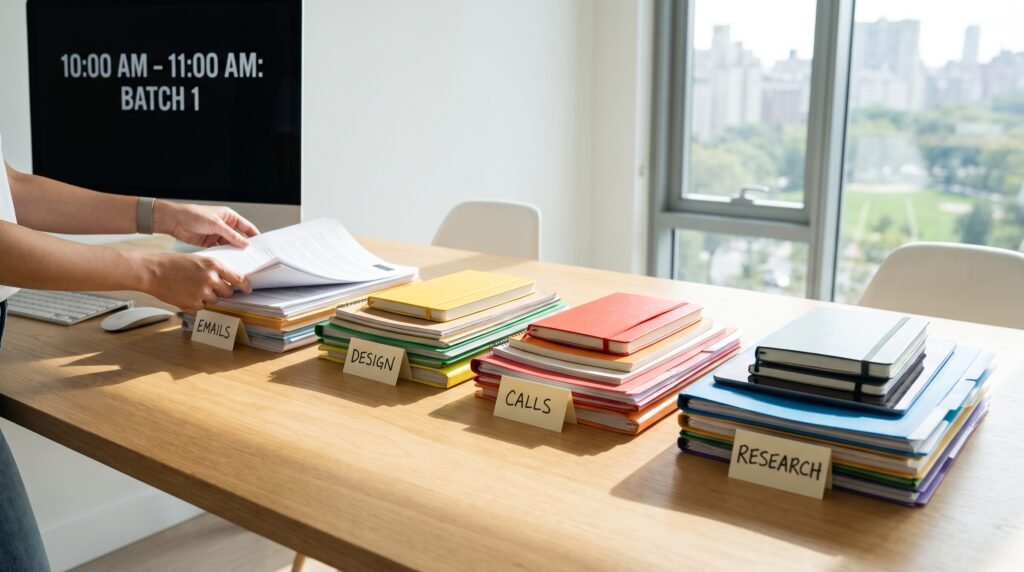
- Batch similar tasks. Don’t check email 40 times a day—set two or three email windows. Group your calls into one block. Batching lets your brain stay in one “mode” instead of constantly reloading a new one.
- Use “if-then” plans for interruptions. Decide in advance: “If a colleague interrupts, then I’ll say I’ll get back to them in 20 minutes.” Pre-deciding removes the split-second temptation to abandon your task.
- Build a shutdown ritual between tasks. To beat attention residue, take 60 seconds to properly “close” a task before opening the next—jot where you left off, mark it done, take a breath. This gives your brain permission to fully let go.
- Start small and scale. Don’t try to overhaul your whole day at once. Commit to one 20-minute single-tasking block tomorrow morning. Once it feels natural, add another. Focus is a muscle; you build it with reps, not willpower marathons.
Your single-tasking starter routine: Tomorrow morning, pick one meaningful task, silence your phone, set a 25-minute timer, close every unrelated tab, and work on just that one thing until the timer rings. That’s it. One block. See how it feels.
Common Myths About Multitasking (Busted)
Let’s clear out a few stubborn beliefs while we’re here:
- Myth: “I’m just naturally good at multitasking.” Reality: Studies consistently show the people most confident in their multitasking are usually the worst at it. Confidence and competence point in opposite directions here.
- Myth: “Multitasking saves time.” Reality: The switching penalty means it almost always costs time. What feels efficient is measurably slower.
- Myth: “Some people are just wired to multitask better.” Reality: A tiny sliver of people (sometimes called “supertaskers”) show minimal switching cost—but it’s rare enough that, statistically, it’s almost certainly not you or me. Assume the bridge is single-lane.
- Myth: “Younger people who grew up with tech multitask better.” Reality: Growing up with more screens means more practice switching, not better performance. If anything, heavy digital multitaskers struggle more with filtering distractions.
Final Thoughts
When you strip away the hustle culture noise and actually compare single tasking vs multitasking, the contest isn’t close. Focus wins on speed, quality, memory, and your day-to-day wellbeing. Multitasking wins only in that narrow case of pairing something mindless with something mindful—and even then, “wins” is generous.
The most freeing thing to remember is this: single-tasking is a skill you rebuild, not a personality trait you were born with or without. If your focus feels shredded right now, that’s not a life sentence. It’s just a muscle that’s out of shape—and every focused block you do puts a little strength back.
So here’s your permission slip: close the extra tabs, silence the phone, and give one thing your whole self. Not everything. Just the next thing. Try a single 25-minute focused block today, and notice how much more you get done—and how much calmer you feel doing it.
What’s the one distraction that derails your focus the most? Naming it is the first step to beating it.